






VLF AC Hipot Test Set
Request a Custom VLF AC Cable Testing Solution
Looking for lightweight, non-destructive VLF AC withstand test sets and Tan Delta diagnostic systems compliant with IEEE 400.2 standards? Weshine manufactures digital 0.1Hz VLF testing equipment engineered for reliable field commissioning of MV/HV underground power cables.
-
Safe for Solid Insulation: True 0.1Hz sinusoidal AC output protects XLPE, EPR, and PILC cables from space charge damage.
-
Integrated Diagnostics: Options for combined VLF withstand testing and high-precision Tan Delta (loss factor) analysis.
-
Ultra-Portable Field Architecture: 500x lower power demand than traditional 50Hz test sets—easily powered by standard field generators.
-
Direct Factory Value: Factory-direct pricing, ISO/CE certified manufacturing, and responsive international technical support.
Contact us to consult with our technical specialists, download detailed specification sheets, or request a factory quote for your Electrical Testing Solutions.
-
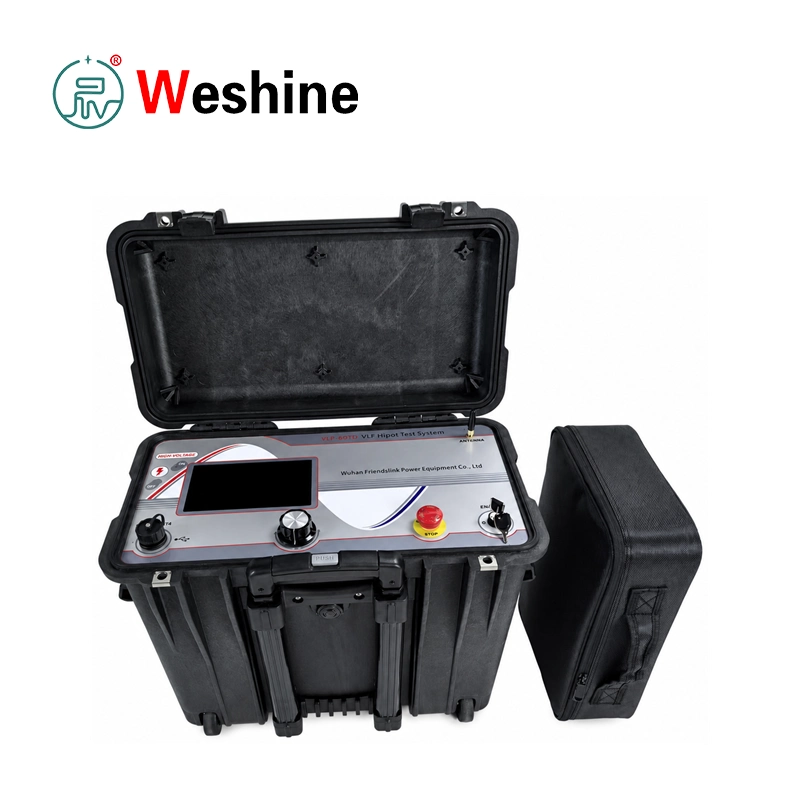
Ultra-Low Frequency VLF Tan Delta Cable Tester | VS-CDPTD
-
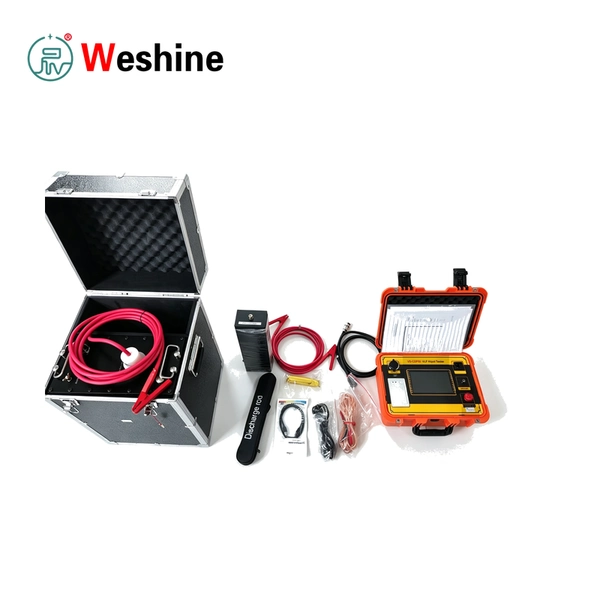
Ultra-Low Frequency Portable VLF Hipot Tester | VS-CDP
VLF AC Hipot Test Set & Very Low Frequency Cable Diagnostics
A VLF AC Hipot Test Set (Very Low Frequency Withstand Testing System) is an essential diagnostic instrument operating at 0.1Hz, 0.05Hz, or 0.02Hz sinusoidal frequency. Specifically designed for testing medium and high-voltage underground power cables (such as XLPE, EPR, and PILC networks), VLF technology addresses the fundamental limitation of traditional 50Hz/60Hz AC testing: the massive capacitive charging power required by long cable runs. By reducing the frequency to 0.1Hz, the reactive power demand drops by 500 times, making field-portable AC withstand testing practical and effective.
As an established Electrical Testing Solutions provider and manufacturer, Weshine engineers digital VLF Hipot Tester units in strict compliance with IEEE 400.2 and IEC 60502 standards. Unlike legacy DC testing—which can induce dangerous space charges in solid insulation—our VLF AC Hipot Tester systems deliver true sinusoidal AC stress to detect water treeing, joint flaws, and insulation defects without compromising cable longevity.
Explore Weshine's complete line of advanced High Voltage Tester equipment to upgrade your field cable testing capabilities.
Featured VLF Cable Testing Systems
Discover our core line of ultra-low frequency testing units engineered for field cable acceptance and insulation loss diagnostics:
-
Ultra Low Frequency Portable VLF Hipot Tester
Ultra-lightweight solution for MV underground cable commissioning. Engineered for 10kV, 22kV, and 33kV XLPE power cables, generator windings, and substation apparatus. Features automatic voltage ramping and digital breakdown detection in a rugged field housing.
-
Ultra Low Frequency VLF Tan Delta Cable Tester
Integrated withstand & loss-factor diagnostic system. Combines 0.1Hz VLF AC withstand testing with high-precision Tan Delta (dissipation factor) measurement to evaluate cable insulation degradation, water tree growth, and thermal aging.
Key Technical Advantages of Weshine VLF Testers
Weshine ultra-low frequency testing systems combine advanced solid-state electronics with digital control interfaces for safe and accurate field operation:
-
Non-Destructive True Sinusoidal AC Stress: Applies pure sinusoidal 0.1Hz voltage stress that reflects operational conditions without embedding damaging residual space charges in solid XLPE or EPR insulation.
-
Low Power Consumption & High Portability: Requires 500 times less power input than power-frequency AC test sets, allowing heavy capacitive loads to be driven using standard field generators or utility mains.
-
Closed-Loop Waveform Regulation: Digital feedback monitoring ensures clean output waveforms with low total harmonic distortion (THD ≤ 1.0%), regardless of connected load capacitance.
-
Integrated Tan Delta Diagnostic Capability: Real-time calculation of dielectric loss factor (tan δ) and capacitance variations to categorize cable health according to IEEE 400.2 guidelines.
-
Multi-Tiered Field Safety Features: Includes automated discharge circuits, over-voltage/over-current fast tripping, zero-start interlocks, and shielded high-voltage output cables.
VLF AC Testing vs. Alternative Insulation Test Methods
Comparing 0.1Hz VLF testing against power-frequency AC and legacy DC testing methods:
| Feature | VLF AC Hipot Tester (0.1Hz) | Power-Frequency AC (50/60Hz) | DC Hipot Tester |
| Equipment Weight & Size | Compact & Field Portable | Very Heavy & Large | Compact & Portable |
| Risk of Damage to XLPE | Non-destructive (Recommended) | Non-destructive | High (Space charge accumulation) |
| Required Input Power | Standard Mains / Small Generator | Substation Source / Large Power Set | Standard Mains / Battery |
| IEEE 400.2 / IEC Compliance | Fully Compliant | Fully Compliant | No longer recommended for XLPE |
Primary Applications of VLF AC Hipot Testing Systems
Very low frequency testing is the globally accepted standard for evaluating high-capacitance electrical assets:
1. Medium & High-Voltage Cable Commissioning
Conducted after cable installation or repair to confirm joint and termination integrity on 10kV to 35kV+ XLPE, EPR, and PILC underground power circuits.
2. Renewable Energy Collector Lines
Ideal for wind and solar farm collection networks where long cable runs prohibit the transport of massive power-frequency testing transformers.
3. Rotating Machine Insulation Diagnostics
Applies low-frequency AC voltage stress to large electric motor windings and generator stator ground wall insulation to evaluate moisture ingress and dielectric degradation.
Frequently Asked Questions About VLF Hipot Testers
Q1: Why is a VLF Hipot Tester preferred over DC testing for XLPE cables?
DC voltage causes trapped electrical space charges in solid extruded insulation such as XLPE. When the cable is returned to service under AC voltage, these space charges create high localized field stress points that can trigger premature insulation breakdown.
Q2: How does a VLF AC Hipot Tester achieve low power consumption?
Power-frequency charging current is proportional to frequency (I = 2π × f × C × U). By dropping the frequency from 50Hz to 0.1Hz (a factor of 500), the reactive power requirement is dramatically reduced, allowing small portable power sources to drive high-capacitance cable loads.
Q3: What is the benefit of adding Tan Delta diagnostics to a VLF test set?
While a basic withstand test is a pass/fail assessment, Tan Delta measurement quantifies the exact level of insulation degradation (such as water treeing or thermal aging), allowing asset managers to schedule predictive maintenance before a complete failure occurs.