






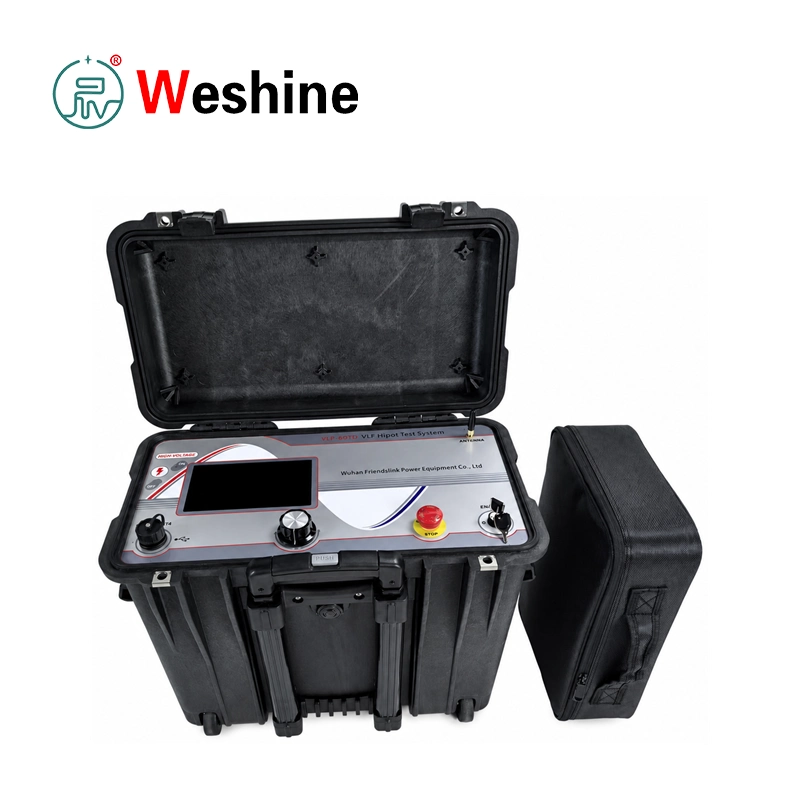


Ultra-Low Frequency VLF Tan Delta Cable Tester | VS-CDPTD
Products Details
VS-CDPTD VLF Tan Delta Cable Tester is designed for high-precision insulation diagnosis and withstand testing of medium-voltage power cables. It integrates VLF AC voltage testing and dielectric loss factor measurement into a single portable test system. Built for cable testing according to relevant CENELEC harmonization documents (HD 620 S1:1996 and HD 621 S1:1996), the system is ideal for PE, XLPE, and paper-insulated cables.
During cable maintenance, insulation defects such as water treeing, aging, contamination, mechanical damage, and partial insulation deterioration may not always be visible through routine visual inspection. Applying a 0.1 Hz VLF sine wave test stresses the cable insulation with AC voltage while requiring significantly lower power capacity than a conventional 50 Hz system, making field testing of long medium-voltage cables far more practical.
As a versatile VLF AC Hipot Tester, the VS-CDPTD delivers a pure VLF sine wave output for AC withstand testing along with direct tan delta measurement. The tan delta test evaluates the dielectric loss factor of the cable insulation, providing clear insights into insulation aging and degradation. The system performs automated dielectric loss testing across multiple voltage levels; the standard automated sequence runs cycles at 0.5 U0, U0, and 1.5 U0. Upon completion, the system automatically saves the results and safely discharges the cable.
The system is available in 34 kV and 45 kV configurations. The 34 kV version provides sine wave output up to 24 kV RMS (34 kV peak), while the 45 kV version delivers up to 31.8 kV RMS (45 kV peak). DC voltage output is also available, ranging from ±1 to 34 kV for the 34 kV configuration and ±1 to 45 kV for the 45 kV configuration. Additionally, the system supports rectangular wave voltage and DC testing modes.
For comprehensive cable sheath maintenance, the VS-CDPTD supports sheath testing and fault pinpointing up to 10 kV. In DC mode, leakage current measurement helps assess relative insulation quality. Built-in breakdown detection automatically disconnects the high-voltage output during flashover or cable failure events to enhance operational protection.
This advanced High Voltage Test Equipment package includes a main test unit, high-voltage connection cable, grounding cable, power cable, USB stick, and accessory bag. It utilizes USB 2.0 for seamless data export and firmware updates. Test records are stored internally and can be exported to a USB drive for detailed report generation via management software. The software can open one to three files simultaneously (corresponding to phases A, B, and C) to generate comprehensive reports complete with test data and dielectric loss curves.
Safety is central to system operation. Because high voltage is generated, operation must be limited to trained personnel who comply with the five fundamental safety rules: disconnect power, prevent re-energizing, confirm absence of voltage, ground and short-circuit, and cover or isolate adjacent live parts. Testing should always be supervised, with at least two operators present during high-voltage operation.
Specifications
Output Voltage
| Item | VS-CDPTD 34 kV Configuration | VS-CDPTD 45 kV Configuration |
| VLF sine wave output voltage | Max. 24 kV RMS / 34 kV peak | Max. 31.8 kV RMS / 45 kV peak |
| DC voltage | ±1 to 34 kV | ±1 to 45 kV |
| Voltage resolution | 0.001 kV | 0.001 kV |
| Voltage accuracy | 1% | 1% |
Output Current
| Item | Specification |
| Measurement range | 0 to 14 mA |
| Resolution | 1 µA |
| Accuracy | 1% |
Maximum Capacitance Load
| Configuration | Frequency And Load |
| 34 kV configuration | 0.1 Hz at 0.5 μF / 24 kV RMS / 34 kV peak |
| 34 kV configuration | 0.05 Hz at 1.0 μF / 24 kV RMS / 34 kV peak |
| 34 kV configuration | 0.01 Hz at 8.0 μF / 18 kV RMS / 25 kV peak |
| 45 kV configuration | 0.1 Hz at 0.5 μF / 31.8 kV RMS / 45 kV peak |
| 45 kV configuration | 0.05 Hz at 1.0 μF / 31.8 kV RMS / 45 kV peak |
| 45 kV configuration | 0.01 Hz at 5.0 μF / 22 kV RMS / 31 kV peak |
Dielectric Loss Factor Measurement
| Item | VS-CDPTD 34 kV Configuration | VS-CDPTD 45 kV Configuration |
| VLF sine tan delta voltage range | 1 to 24 kV RMS | 1 to 31.8 kV RMS |
| Load range | 1 nF to 8 μF | 1 nF to 5 μF |
| Resolution | 1 × 10⁻⁵ | 1 × 10⁻⁵ |
| Accuracy | 1 × 10⁻⁴ | 1 × 10⁻⁴ |
| Measurement range | 1 × 10⁻⁴ to 9999.9 × 10⁻⁴ | 1 × 10⁻⁴ to 9999.9 × 10⁻⁴ |
| Tan delta measurement frequency | 0.1 Hz | 0.1 Hz |
General Information
| Item | VS-CDPTD 34 kV Configuration | VS-CDPTD 45 kV Configuration |
| Power consumption | Max. 300 VA | Max. 400 VA |
| Reverse voltage protection | 13 kV | 15 kV |
| Data interface | USB 2.0 | USB 2.0 |
| Dimensions | Peli Case 1430, 430 × 240 × 340 mm | Peli Case 1430, 430 × 240 × 340 mm |
| Weight | 22 kg | 22 kg |
| Operating ambient temperature | -10°C to +50°C | -10°C to +50°C |
| Storage temperature | -20°C to +60°C | -20°C to +60°C |
Safety And EMC
| Item | Specification |
| Low Voltage Directive | 2014/35/EU |
| Electromagnetic Compatibility Directive | 2014/30/EU |
| Environmental impact reference | EN 60068-2 and subsequent versions |
| User interface languages | English, Chinese Simplified, Russian, Spanish, and others |
Connections And Controls
| Item | Description |
| Display | LCD display |
| High-voltage indication | High-voltage output indicator |
| Data interface | USB 2.0 interface |
| Control | Rotary encoder |
| Emergency control | Emergency stop button |
| Output safety | High-voltage output lock |
Standard Accessories
| Item | Specification |
| Test main unit | 1 set |
| Main power cable | 2.5 m |
| Grounding cable | 4 m |
| High-voltage connection cable | 5 m |
| USB stick | 1 pc |
| Accessory bag | 1 set |
How the System Works
The VS-CDPTD VLF Tan Delta Cable Tester functions by applying a controlled 0.1 Hz sine wave voltage to the test object. Compared to 50 Hz power-frequency testing, the ultra-low frequency approach drastically lowers the current demand for capacitive cable loads, enabling convenient field testing of medium-voltage cables using portable equipment.
Prior to connection, operators must observe the five high-voltage safety rules: ensure the cable is de-energized, isolated, checked for absence of voltage, grounded, and short-circuited, with adjacent live parts shielded or isolated. Testing must be conducted by trained personnel under two-person supervision.
System connection should follow a strict sequence:
-
Connect the system grounding cable to the main test unit, then attach it to the station protective earth.
-
Connect the high-voltage cable to the unit's high-voltage output.
-
Attach the inner conductor of the high-voltage cable to the target phase or sheath using proper accessories.
-
Connect the high-voltage cable shield to a grounding bar near the cable termination.
-
Plugin the main power cable.
For VLF withstand testing, select the target waveform, voltage, frequency, and test duration. The display provides real-time feedback on peak voltage, current, output waveform, set voltage, frequency, and RMS values. The timer initiates once the voltage reaches the set point.
For tan delta testing, select the dielectric loss function and enter the cable's rated phase voltage U0. The system automatically executes the dielectric loss test sequence, taking approximately 3 minutes and 30 seconds per test. It measures cable capacitance, resistance, average dielectric loss, and real-time dielectric loss across 0.5 U0, 1.0 U0, and 1.5 U0.
Upon completion, results are saved automatically, and the cable is discharged. Users can review historical files, export records via USB 2.0, and generate reports using dedicated software. The software supports opening phases A, B, and C simultaneously to display loss curves and produce printable documentation.
For sheath testing or pinpointing, ensure the cable sheath is ungrounded at both ends without indirect ground paths through joints or accessories. Sheath testing and fault pinpointing are supported up to 10 kV.
Features
- Supports VLF sine wave AC withstand testing.
- Supports integrated dielectric loss factor tan delta testing.
- Supports 34 kV and 45 kV peak voltage configurations.
- Provides sine wave output up to 24 kV RMS or 31.8 kV RMS.
- Provides DC voltage output for additional insulation testing.
- Supports rectangular wave voltage output.
- Measures leakage current in DC mode.
- Provides sheath testing and sheath fault pinpointing up to 10 kV.
- Automatically performs dielectric loss test sequences at 0.5 U0, U0, and 1.5 U0.
- Displays real-time peak voltage and current during testing.
- Displays real-time output waveform during testing.
- Detects voltage breakdown and automatically disconnects high-voltage output.
- Stores test logs in internal memory.
- Exports test records through USB 2.0.
- Supports report generation using dedicated viewing software.
- Supports firmware updates through USB.
- Provides multilingual user interface including English and Simplified Chinese.
- Includes emergency stop button and high-voltage output lock.
- Provides reverse voltage protection.
- Supports field cable testing with portable Peli case design.
Application Scenarios
- Power Utilities
Power utilities use the VS-CDPTD for medium-voltage cable commissioning, preventive maintenance, tan delta diagnosis, sheath testing, and cable insulation assessment in distribution networks and substations. - Transformer Manufacturers
Transformer and electrical equipment manufacturers can use the system for insulation-related cable and component testing where VLF voltage and dielectric loss measurement are required. - Power Plants
Power plants use the VS-CDPTD for station cable testing, generator auxiliary cable maintenance, sheath testing, and insulation diagnosis during outages. - Railways
Railway power supply systems use medium-voltage cables in traction substations and distribution lines. The VS-CDPTD supports cable withstand testing and tan delta evaluation during maintenance windows. - Industrial Plants
Mining, petrochemical, steel, and manufacturing plants can use the system for medium-voltage cable acceptance testing, preventive maintenance, and sheath fault investigation. - Universities
Universities and research institutes can use the VS-CDPTD for teaching VLF cable testing, dielectric loss measurement, insulation deterioration analysis, and high-voltage safety procedures. - Testing Laboratories
High-voltage and cable testing laboratories can use the instrument for VLF withstand testing, tan delta measurement, sheath testing, and third-party cable diagnostic services. - Cable Maintenance
Cable maintenance teams use the VS-CDPTD for XLPE cable testing, PE cable testing, paper-insulated cable assessment, water tree diagnosis, sheath fault pinpointing, and report generation.
Applications
- VLF sine wave cable withstand testing.
- Medium-voltage cable tan delta testing.
- XLPE cable insulation diagnosis.
- PE cable withstand testing.
- Paper-insulated cable testing.
- Cable water tree deterioration assessment.
- Cable sheath testing up to 10 kV.
- Cable sheath fault pinpointing.
- DC voltage testing.
- Rectangular wave voltage testing.
- Leakage current measurement in DC mode.
- Cable commissioning tests.
- Cable preventive maintenance tests.
- Three-phase cable report generation.
- Internal memory logging and USB data export.
Customer Case
-
Industry: Medium-voltage cable maintenance
-
Problem: A utility maintenance crew needed to assess several operational medium-voltage XLPE cable feeders. While a standard withstand test would verify breakdown strength, the team required dielectric loss data to quantify insulation aging and detect potential water tree degradation.
-
Testing Process: Technicians isolated the cable, applied the five safety rules, grounded the setup, and connected the VS-CDPTD according to the manual. Selecting tan delta testing mode, they entered the rated phase voltage U0, released the emergency stop and high-voltage lock, and initiated the automated test. The system measured dielectric loss across 0.5 U0, U0, and 1.5 U0, saved the data, and discharged the cable safely.
-
Result: Test files were exported via USB, and phase comparison reports were generated using the viewing software. Feeders exhibiting healthy loss factor trends were kept in service, while those showing signs of deterioration were scheduled for targeted maintenance.
-
Benefits: The utility gained both withstand testing and diagnostic tan delta capabilities in a single portable device, while automated operations and software reporting simplified documentation and enhanced data integrity.
FAQ
-
What is the primary function of the VS-CDPTD?
It is used for medium-voltage cable VLF withstand testing, tan delta dielectric loss measurement, sheath testing, sheath fault pinpointing, DC testing, rectangular wave testing, and leakage current analysis.
-
How does VLF withstand testing differ from tan delta testing?
VLF withstand testing verifies if cable insulation can withstand a specific AC voltage without breakdown. Tan delta testing measures the dielectric loss factor to quantify insulation health, aging, and moisture degradation.
-
What output voltage configurations are available?
The unit comes in 34 kV and 45 kV peak configurations. The 34 kV model outputs up to 24 kV RMS / 34 kV peak, while the 45 kV model delivers up to 31.8 kV RMS / 45 kV peak.
-
What is the operating frequency for tan delta measurement?
The tan delta measurement operates at a fixed ultra-low frequency of 0.1 Hz.
-
What capacitance load range is supported during tan delta testing?
The 34 kV version supports loads from 1 nF to 8 μF; the 45 kV version supports loads from 1 nF to 5 μF.
-
Can test records be exported?
Yes. Test records are logged internally and can be exported via USB 2.0 to dedicated software for comprehensive report generation.
-
Does the system assist with sheath fault location?
Yes, it supports sheath testing and precise sheath fault pinpointing up to 10 kV.
-
What key safety procedures must be observed?
Only certified personnel should operate the unit. Cables must be de-energized, isolated, and grounded prior to connection. High-voltage testing must be conducted under dual-person supervision, utilizing the emergency stop and safety output lock as mandated.
Weshine Advantages
Weshine Electric provides electrical testing equipment for utilities, cable maintenance teams, contractors, laboratories, and industrial users. For VLF and tan delta cable testing, Weshine focuses on practical field operation, stable high-voltage output, diagnostic measurement, data storage, and report support. Weshine can assist customers with model selection, cable test configuration, safety workflow, and customized application requirements. With engineering experience, quality control, technical support, reliable testing solutions, and international service, Weshine helps users perform cable withstand testing and insulation diagnosis with clear, traceable results.