






Transformer DC Winding Resistance Tester
Looking for a certified B2B manufacturer of Transformer DC Winding Resistance Testers? Weshine manufactures high-precision portable and multi-channel winding resistance meters designed for power utilities, transformer factories, and high-voltage maintenance service companies. Efficiently measure winding resistance, verify tap changer contacts, and diagnose internal winding faults with full IEC 60076 compliance. Direct factory pricing and bulk supply available.
Need a factory quote or technical selection support?
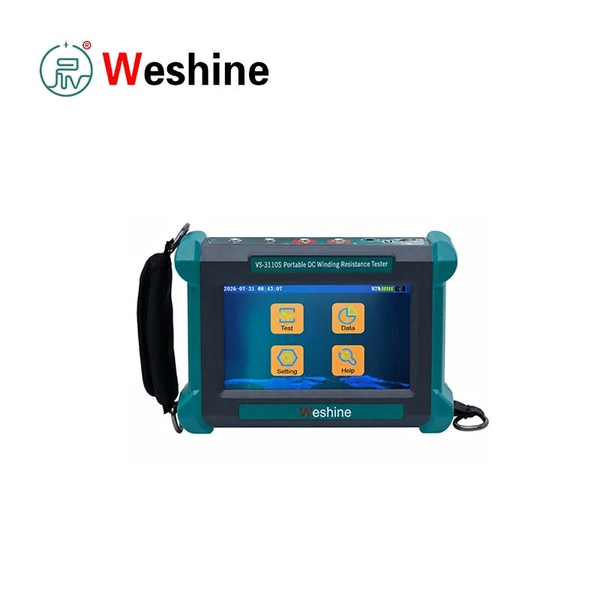
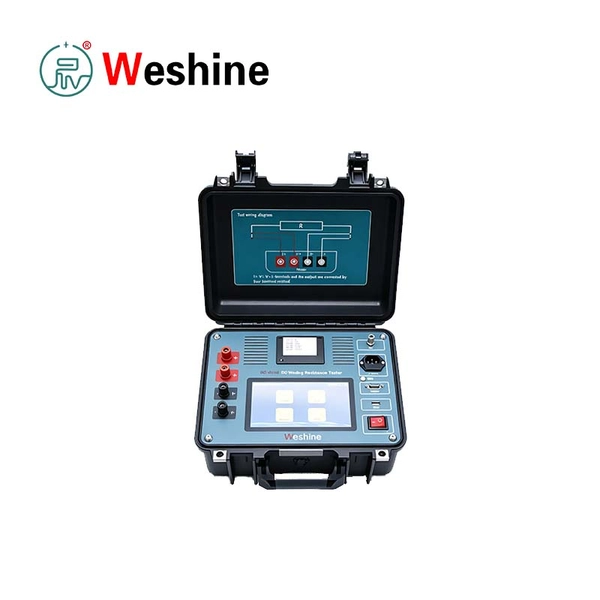
Transformer DC Winding Resistance Tester for HV Maintenance & Manufacturing
DC winding resistance measurement is a mandatory routine test during transformer manufacturing, factory acceptance testing (FAT), commissioning, and routine maintenance. As a dedicated Electrical Testing Equipment Supplier, Weshine provides high-performance Transformer DC Winding Resistance Testers engineered to evaluate internal winding health and contact integrity.
Using an advanced transformer winding resistance meter, test engineers can quickly detect internal loose connections, winding strand breakage, tap changer contact oxidation, and shorted turns under high constant-current excitation. Fast magnetic saturation algorithms dramatically reduce testing time on large capacitive power transformers, boosting field testing efficiency and safety.
Supported Transformer & Asset Types
Our transformer DC resistance testers provide comprehensive resistance evaluation across various power grid assets:
-
Power Transformers: Large step-up and step-down transformers in high-voltage transmission substations.
-
Distribution Transformers: Oil-immersed and dry-type distribution transformers requiring fast field inspection.
-
On-Load Tap Changers (OLTC) & OCTC: Dynamic and static contact resistance measurement across all tap positions.
-
Reactors & Large Motors: High-inductance inductive loads requiring high current output and fast stabilization.
Why Measure Transformer DC Winding Resistance?
Integrating a high-precision Transformer DC Winding Resistance Tester into your maintenance or manufacturing quality control workflow delivers critical diagnostic benefits:
Detect Internal Mechanical & Electrical Defects
Identifies latent internal faults before catastrophic breakdown:
-
Broken winding strands or defective brazed joints.
-
Tap changer contact degradation, misalignments, or surface oxidation.
-
Loose bushings and internal lead connections.
-
Partial short-circuit conditions within windings.
Verify Transformer Manufacturing Quality
Ensures that winding resistance matches factory design specifications, phase-to-phase balance ratios, and thermal calculation standards.
Fast Demagnetization & Safety Protection
Advanced automatic discharge and demagnetization circuits protect both operators and delicate measuring instruments from high back-EMF inductive spikes upon test completion.
Featured Transformer Resistance Testing Hardware
Weshine provides both portable field instruments and high-current benchtop testers to meet diverse B2B procurement needs:
-
Handheld Transformer DC Resistance Tester — Compact, ultra-portable lithium-battery-powered winding resistance tester designed for rapid outdoor substation inspection, pole-mounted transformer testing, and field maintenance teams.
-
10A Transformer DC Resistance Tester — Precision 10A constant-current winding resistance meter featuring fast stabilization algorithms, dual-channel measurement, automated temperature compensation, and onboard thermal printing for power transformers and OLTC testing.
Applications of Winding Resistance Testers
Our Transformer DC Winding Resistance Testing Equipment is deployed across critical power sector workflows:
Transformer Manufacturing Plants
-
Factory Acceptance Testing (FAT): Measuring cold winding resistance for baseline thermal rise calculations and phase balance verification.
-
Quality Assurance Inspection: Verifying winding turn integrity and tap changer contact resistance before tank oil filling.
Power Utilities & Substation Operators
-
Commissioning & Installation Acceptance: Establishing baseline resistance data prior to energizing new substation bays.
-
Preventive Maintenance & Post-Fault Troubleshooting: Diagnostic testing following short-circuit fault trips or abnormal thermal alarms.
Independent Testing & Maintenance Laboratories
-
Diagnostic Condition Assessment: High-precision resistance measurement for transformer life-extension programs and asset management.
Key Features of Our Winding Resistance Testers
-
High Current Output & Fast Stabilization: Constant current source options (up to 10A / 20A / 40A) rapidly saturate inductive cores to deliver stable resistance readings in seconds.
-
Automated Temperature Conversion: Converts measured resistance values to standard baseline temperatures (e.g., 75℃ or 85℃) automatically based on winding material (Copper/Aluminum).
-
Dual & Multi-Channel Simultaneous Testing: Measures high-voltage and low-voltage windings simultaneously to accelerate testing on complex power transformers.
-
Complete Safety & Auto-Discharge Protection: Audio-visual discharge alarms and hardware protection circuits safely bleed off residual inductive energy.
-
Digital Data Management: Built-in storage, USB export capability, and thermal printing for instant field report generation.
Winding Resistance Testing Standards
All Weshine Transformer DC Winding Resistance Testers are engineered in compliance with international electrical testing standards:
| Standard / Guideline | Application & Technical Requirements |
| IEC 60076-1 | Power transformers – Measurement of winding resistance and phase balance specifications |
| IEEE C57.12.90 | Standard test code for liquid-immersed distribution, power, and regulating transformers |
| IEEE C57.12.91 | Standard test code for dry-type distribution and power transformers |
How to Choose the Right Winding Resistance Tester
Selecting the optimal transformer resistance tester depends on your asset portfolio, voltage class, and field operational requirements:
1. Based on Transformer Capacity & Voltage Level
-
Distribution & Small Transformers: A compact unit like our Handheld Transformer DC Resistance Tester provides ultimate portability and battery-powered field speed.
-
Large Power Transformers & Substations: Select a higher current model such as our 10A Transformer DC Resistance Tester to overcome high core inductance and achieve rapid reading stabilization.
2. Based on Tap Changer Testing Needs
If testing transformers equipped with On-Load Tap Changers (OLTC), select a tester with continuous testing capability that allows switching tap positions without interrupting excitation current.
3. Based on Operational Environment
-
Substation Field Testing: Look for ruggedized enclosures, battery powered options, anti-interference filtering, and built-in thermal printers.
-
Factory QA Bay: Prioritize multi-channel acquisition, high accuracy micro-ohm resolution, and PC data logging software.
Why Choose Weshine as Your B2B Equipment Supplier?
Weshine is a premier Chinese manufacturer of comprehensive high-voltage testing instruments:
-
Direct Factory Supply & B2B Wholesale: Cost-effective pricing with OEM/ODM customization for global test equipment distributors and utilities.
-
Complete High-Voltage Testing Portfolio: Seamlessly combine winding resistance meters with TTR testers, AC Hipot systems, and oil diagnostic equipment.
-
Comprehensive Technical Service: Backed by engineering support for calibration, custom software integration, and operator training.
Frequently Asked Questions
Q1: Why is DC excitation used to measure transformer winding resistance?
DC current is used to eliminate AC inductive reactance, allowing direct, accurate measurement of pure DC winding resistance ($R$). High DC current saturates the magnetic core rapidly to stabilize the reading.
Q2: What causes winding resistance imbalance in a transformer?
Resistance imbalance between phases can be caused by broken winding strands, loose bolted lead connections, defective tap changer contacts, inter-turn short circuits, or poor internal brazing joints.
Q3: Why is automated temperature conversion necessary?
Winding resistance increases with temperature. To compare field test results with factory baseline data or guaranteed values, measured resistance must be automatically converted to standard reference temperatures (e.g., 75℃) using temperature compensation formulas.
Q4: Why is automatic discharge protection important during DC testing?
Transformer windings store significant magnetic energy under DC current. Disconnecting test leads without proper discharge can cause severe electrical arc flashing, high back-EMF voltage spikes, equipment damage, and operator danger. All Weshine testers feature automated safety discharge systems.