






Lightning Arrester Tester
Looking for a high-precision surge arrester tester to evaluate zinc-oxide surge arrester (MOA) health? Weshine Electric is a professional manufacturer of high-voltage testing equipment and power system diagnostic instruments. Our surge arrester testers measure total leakage current, fundamental current, and 3rd harmonic resistive current under energized operating conditions. Detect moisture ingress, valve aging, and insulation breakdown before catastrophic failure occurs. Explore our portable diagnostic units or complement your fleet with a ground earth resistance tester.
Need technical specifications or direct factory pricing?
Lightning Arrester Tester & Surge Arrester Diagnostics
Surge arresters (metal-oxide arresters / MOAs) are critical protective devices in power utilities, high-voltage substations, and industrial distribution grids. They shield expensive power transformers, circuit breakers, and switchgear from atmospheric lightning strikes and operational switching overvoltages. However, prolonged exposure to system stress, moisture ingress, and thermal overload causes internal zinc-oxide (ZnO) valve block degradation, resulting in increased resistive leakage current, thermal runaway, and explosive failure.
As a trusted manufacturer of electrical testing equipment, Weshine Electric develops high-precision lightning arrester testers and portable surge arrester diagnostic instruments. Engineered with advanced harmonic analysis, digital signal processing (DSP), and high anti-interference filtering, our testers allow maintenance engineers to evaluate live surge arrester health without de-energizing the grid.
Featured Surge Arrester Testing Products
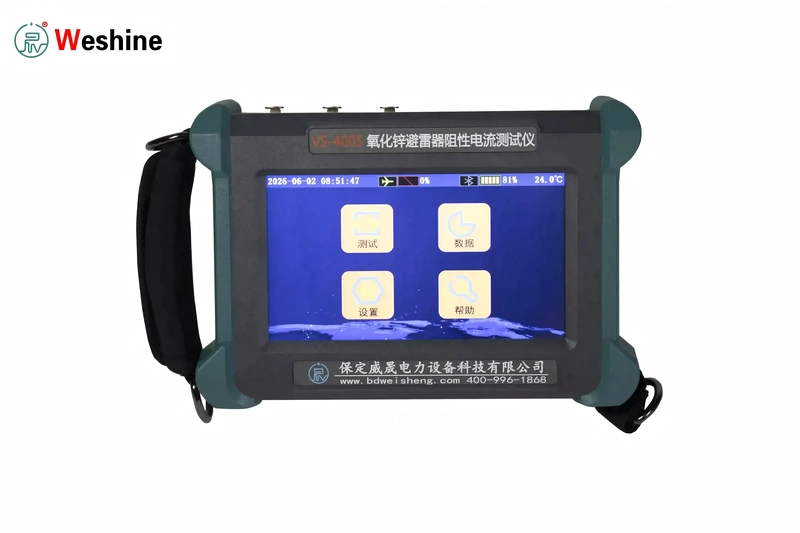
Explore our handheld field diagnostic unit engineered for live metal-oxide surge arrester inspection:
Handheld MOA Resistive Current Tester
A compact, battery-powered diagnostic instrument designed for live-line measurement of resistive leakage current in metal-oxide surge arresters (MOAs). Features wireless PT voltage sampling and harmonic spectrum analysis.
-
Core Measurement: Measures total leakage current, fundamental current, 3rd / 5th / 7th harmonic resistive currents, and active power loss.
Applications of Lightning Arrester Testers
High-Voltage Substations & Power Utilities
-
Live On-Site MOA Audits: Measuring resistive leakage current on 10 kV to 500 kV substation surge arresters under full operating AC voltage.
-
Routine Preventive Maintenance: Conducting periodic health evaluations on line arresters to track valve block insulation aging trends over time.
Industrial Power Distribution & Renewable Energy
-
Wind & Solar Farm Grid Protection: Auditing surge protection units installed at wind turbine step-up transformers and photovoltaic collector stations.
-
Manufacturing Facilities: Verifying entrance surge arrester integrity to protect sensitive automated production machinery from grid transients.
Commissioning & Factory Acceptance Testing
-
Pre-Installation Verification: Measuring DC reference voltage (U1mA) and leakage current under 0.75 U1mA during de-energized acceptance audits.
Key Diagnostic Indicators: Total Current vs. Resistive Current
A high-performance surge arrester tester separates capacitive current from resistive current to deliver true diagnostic accuracy:
| Measurement Parameter | Physical Cause & Diagnostic Significance |
| Total Leakage Current (Ix) | The total vector sum of capacitive and resistive current across the arrester stack. |
| Capacitive Current (Ic) | Dominated by the dielectric capacitance of the ZnO block; typically stable over time. |
| Resistive Current (Ir) | Directly reflects valve block aging, grain boundary contamination, and moisture ingress. |
| 3rd Harmonic Resistive Current (Ir3p) | The primary diagnostic indicator used to detect non-linear thermal aging and moisture contamination. |
Technical Features & Engineering Innovations
Advanced Harmonic Analysis Technology
Utilizes Fourier transform analysis to isolate the 3rd harmonic resistive current component (Ir3p) from the total leakage current, providing reliable fault detection even in high-interference substation environments.
Wireless Voltage Reference Sampling
Offers optional wireless PT (potential transformer) voltage signal transmission or non-PT reference calculation, eliminating long trailing test leads and enhancing operator field safety.
Field-Portable & Rechargeable Design
Housed in an ergonomic, impact-resistant enclosure equipped with high-capacity lithium batteries, suitable for all-day field testing across remote substation sites.
Internal Data Storage & Report Generation
Displays real-time current waveforms, harmonic spectrum bar charts, and resistance parameters on a backlit color LCD, supporting onboard memory saving and USB data transfer.
Advantages of Weshine Lightning Arrester Testers
-
Early Fault Detection: Pinpoints subtle increases in micro-ampere (μA) resistive leakage current long before thermal runaway triggers an explosive failure.
-
Live-Line Non-Destructive Testing: Perform comprehensive condition assessments while the surge arrester remains energized under actual system voltage.
-
High Anti-Interference Architecture: Digital filtering rejects strong electromagnetic field noise typical of 220 kV and 500 kV live switchyards.
-
Operational Safety Guarantees: Built with high-voltage isolation probes, current clamping sensors, and automatic overcurrent protection.
International Testing Standards
Our surge arrester testers strictly comply with international industry standards:
| Standard | Description / Scope |
| IEC 60099-4 | Surge arresters – Part 4: Metal-oxide surge arresters without gaps for A.C. systems |
| IEEE C62.11 | IEEE Standard for Metal-Oxide Surge Arresters for AC Power Circuits (>1 kV) |
| IEC 60099-5 | Surge arresters – Part 5: Selection and application recommendations |
How to Select the Right Surge Arrester Tester
When choosing a lightning arrester tester, evaluate these primary technical requirements:
-
Testing Environment (Live vs. Offline): Select a Handheld MOA Resistive Current Tester for live energized inspections, or a DC high-voltage generator for offline U1mA testing.
-
Voltage Sampling Method: Decide between direct PT voltage reference inputs, wireless PT transmission, or software-based voltage projection.
-
Substation Diagnostic Fleet Integration: Pair your surge arrester diagnostic units with a high-accuracy ground earth resistance tester to verify low-impedance ground discharge paths.
Why Choose Weshine Electric
Direct Manufacturer Expertise
Weshine Electric is a professional manufacturer of high-voltage testing equipment and power diagnostic instruments. With strong engineering capability and strict quality control, we build instruments that deliver dependable field performance.
Comprehensive Substation Testing Fleet
From handheld MOA testers and insulation resistance meters to transformer diagnostic sets and VLF hipot testers, we provide full-spectrum equipment for power utilities.
Global B2B Technical Support & Direct Pricing
We serve global power utilities, grid operators, and electrical contractors with technical consultation, calibration services, OEM/ODM solutions, and direct factory pricing.
Related Products & Category Links
Explore complementary high-voltage testing equipment from our portfolio:
-
Ground Earth Resistance Tester Category — Soil resistivity and ground grid impedance testing equipment.
-
Weshine Homepage — Explore our complete catalog of electrical diagnostic tools.
-
Contact Sales Engineers — Request technical datasheets, quotation, or factory pricing.
Frequently Asked Questions (FAQ)
Q1: What is a lightning arrester tester used for?
A lightning arrester tester evaluates the operational health and insulation condition of surge arresters (MOAs). It measures leakage current, resistive current, and harmonic components to detect valve block degradation, aging, and moisture contamination.
Q2: Why is resistive leakage current critical when testing a metal-oxide arrester?
While total leakage current across an MOA is mostly capacitive, the resistive current component reflects real power loss and internal heating. An increase in resistive current indicates thermal degradation or moisture ingress, which can lead to thermal runaway.
Q3: Can a surge arrester tester perform live-line testing?
Yes. Modern diagnostic units like our handheld MOA tester measure total current via high-precision current clamps and isolate the resistive component using PT voltage references or harmonic projection, allowing safe testing while the grid is fully energized.
Q4: How often should substation surge arresters be tested?
Major power utilities typically perform live surge arrester diagnostic checks annually, before high-lightning seasonal peaks, or immediately following severe grid transient events.