






Cable Fault Location System
Searching for a high-precision cable fault distance locator for underground cable repair? Weshine Electric is an experienced Electrical Test Equipment Manufacturer. Our integrated cable fault location systems combine TDR pre-location distance measurement, high-energy surge discharge (thumping), and acoustic-magnetic pinpointing to identify open circuits, high-resistance flashovers, and insulation breakdown fast. Reduce excavation areas and restore power network reliability. Explore our product fleet or browse our parent cable fault locating system catalog.
Need technical datasheets or direct factory pricing?
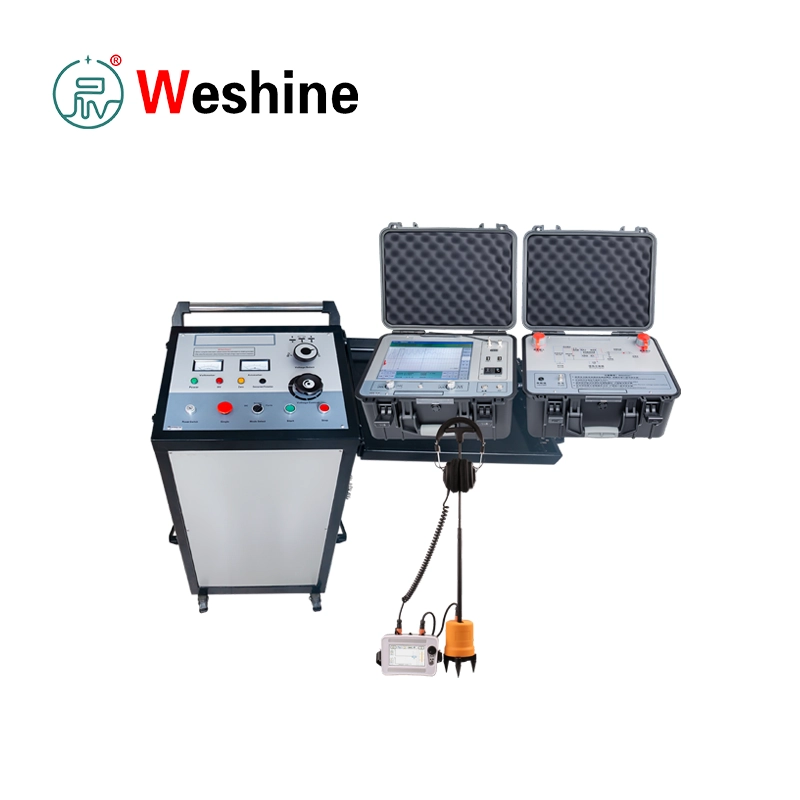
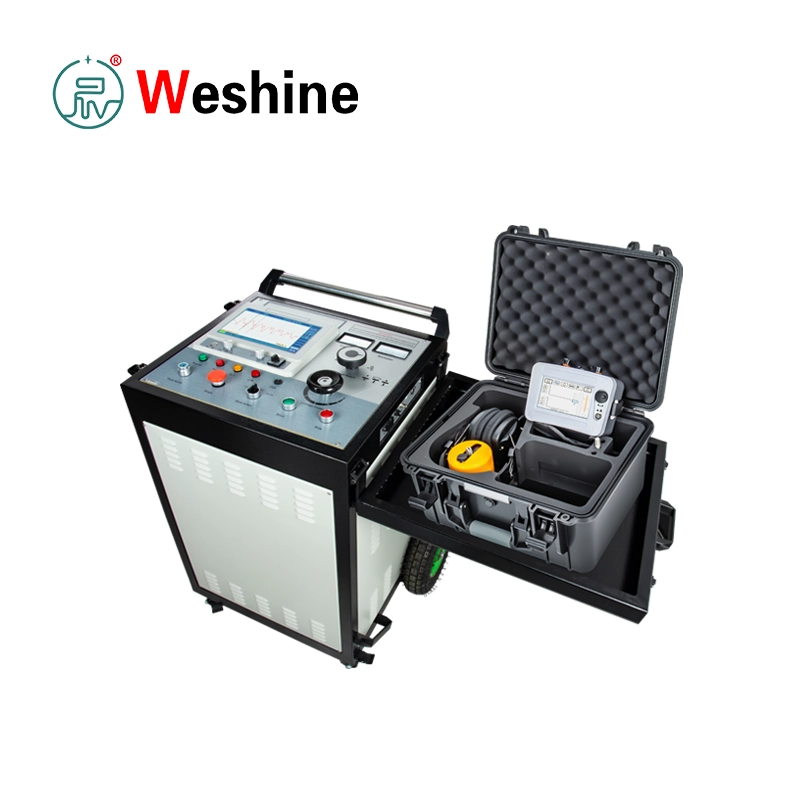
Cable Fault Distance Locator & Acoustic Pinpointing Systems
When an underground power cable suffers an insulation breakdown or short circuit, field service engineers face two distinct operational challenges: determining the overall distance to the fault along the cable route, and pinpointing the exact physical spot beneath soil or concrete.
As a specialized high-voltage diagnostic equipment manufacturer, Weshine Electric provides advanced cable fault distance locators, acoustic cable fault pinpointers, and high-energy thumper cable fault locators. By seamlessly unifying Time-Domain Reflectometry (TDR) with surge-impulse technology and acoustic-magnetic field receivers, our systems deliver sub-meter pinpoint accuracy, dramatically lowering trench excavation costs and outage recovery time.
Applications of Cable Fault Distance Locators & Pinpointers
Power Utilities & Distribution Grids
-
Rapid Emergency Fault Recovery: Swiftly measuring fault distance and pinpointing underground breakdown sites during unexpected feeder outages.
-
Preventive Cable Maintenance: Detecting developing water treeing, partial discharge damage, and high-resistance insulation weakness prior to catastrophic failure.
-
Underground Distribution Line Repairs: Guiding digging crews directly over damaged medium-voltage (MV) and high-voltage (HV) cables.
Industrial Facilities & Substation Maintenance
-
Plant Infrastructure Power Continuity: Restoring critical underground supply cables in chemical plants, refineries, steel mills, and mining operations.
-
Substation Interconnect Diagnostics: Evaluating long-distance tie-lines between transformers, switchgear, and power distribution centers.
Cable Manufacturing & Engineering Contractors
-
Post-Installation Acceptance Testing: Pinpointing installation-induced mechanical defects, sheath damage, or joint failures before final grid connection.
-
Factory Defect Verification: Verifying drum-wound cable insulation continuity post-manufacture.
Featured Cable Fault Location Systems
Explore our flagship integrated diagnostic systems built for complete pre-location, thumping, and pinpointing workflows:
32kV Integrated Cable Fault Location System
An all-in-one portable solution integrating high-voltage surge generation (thumper), TDR distance pre-location, and high-voltage DC withstand testing in a compact trolley casing.
-
Max Output Voltage: Up to 32 kV high-voltage surge output with multi-stage surge energy control.
-
Explore Product: View 32kV Integrated Cable Fault Location System Details
35kV Underground Cable Fault Testing System
Engineered specifically for heavy-duty 35 kV medium-to-high voltage power networks. Delivers high discharge surge energy to trigger clear acoustic sparkovers across stubborn, high-resistance fault gaps.
-
Max Output Voltage: Up to 35 kV continuous surge pulse capability for deep-buried utility lines.
-
Explore Product: View 35kV Underground Cable Fault Testing System Details
Core Technologies: Distance Pre-Location vs. Ground Pinpointing
Achieving accurate fault location requires combining two distinct diagnostic technologies:
| Functional Stage | Primary Instrument | Technology Used & Diagnostic Goal |
| Stage 1: Distance Pre-Location | Cable Fault Distance Locator | Uses Time-Domain Reflectometry (TDR) or Arc Reflection Methods (ARM) to calculate the exact distance (in meters) from the cable end to the fault point. |
| Stage 2: High-Voltage Thumping | Thumper Cable Fault Locator | Discharges high-voltage capacitors into the faulted cable, creating high-energy breakdown arcs and periodic acoustic discharge "thumps." |
| Stage 3: Ground Pinpointing | Cable Fault Pinpointer | Ground-level receiver that detects synchronized acoustic discharge sounds and electromagnetic pulses to pinpoint the exact digging point. |
Advanced Operating Features & Engineering Technology
High-Energy Surge Pulse Generation (Thumper)
Features multi-stage high-voltage surge capabilities (e.g., 0 to 8 kV / 16 kV / 32 kV / 35 kV) delivering high discharge energy (500 J to 2048 J), making breakdown arcs clearly audible at ground level even through dense pavement or deep direct-buried soil.
Multi-Method Distance Pre-Location
Supports Low-Voltage Pulse TDR, Arc Reflection Method (ARM), Current Impulse Method (ICM), and Voltage Decay methods. Automatically calculates wave velocity and fault distance, presenting clear waveform comparisons on digital color displays.
Intelligent Acoustic-Magnetic Pinpointing Receivers
Equipped with digital noise-reduction filters, real-time background noise suppression, and synchronized acoustic-magnetic delay indication, guiding field operators directly to the fault point with visual sub-meter distance prompts.
Key Advantages of Weshine Cable Location Systems
-
Sub-Meter Pinpointing Precision: Drastically reduces pavement destruction and excavation labor expenses.
-
High-Power Field Adaptation: Designed with heavy-duty shock resistance, thermal protection, and robust wheels for easy field transport across rugged utility terrains.
-
Comprehensive Safety Protection: Integrated zero-voltage start protection, automatic high-voltage discharge grounding switches, and physical safety interlocks.
-
Versatile Range Coverage: Equally effective on low-voltage (LV), medium-voltage (MV), and high-voltage (HV) underground power cables.
Cable Fault Diagnosis Workflow
Field crews follow a structured 4-step process when deploying a thumper cable fault locator system:
-
Pre-Testing & Continuity Inspection: Identify phase continuity and insulation resistance using a megohmmeter to classify the fault (open circuit, short circuit, or high resistance).
-
Distance Pre-Location: Connect the TDR distance locator to calculate approximate fault distance (e.g., 450 meters from the station).
-
High-Voltage Surge Thumping: Charge and discharge the surge capacitor periodically (every 3 to 5 seconds) to trigger repeated breakdown arcs at the fault point.
-
Ground Acoustic-Magnetic Pinpointing: Walk the mapped cable route with the ground receiver, following the acoustic-magnetic timing prompts until the peak acoustic signal is pinpointed.
How to Choose the Right Cable Location Equipment
When evaluating a cable fault distance locator or thumper cable fault locator, consider the following parameters:
-
Cable System Voltage: Select surge generators with voltage steps matching your network class (e.g., 32 kV / 35 kV for MV/HV utility lines).
-
Surge Discharge Energy (Joules): High energy ensures sufficient acoustic impact for deep-buried or duct-run cables.
-
Integration Level: Integrated trolley-mounted units streamline field operations by combining TDR, high-voltage surge generator, and control panels into a single transportable system.
International Testing Standards
| Standard | Description |
| IEEE 1234 | IEEE Guide for Fault-Locating Methods for Underground Transmission and Distribution Cable Systems |
| IEC 60502 | Power cables with extruded insulation and their accessories for rated voltages from 1 kV up to 30 kV |
| IEC 60840 | Power cables with extruded insulation and their accessories for rated voltages above 30 kV up to 150 kV |
Why Choose Weshine Electric
Recognized Test Equipment Manufacturer
As a dedicated Electrical Test Equipment Manufacturer, Weshine Electric delivers field-proven diagnostic tools engineered to meet demanding international standards.
Complete End-to-End Cable Diagnostic Portfolio
From low-voltage cable tracers and TDR distance meters to 35 kV high-energy surge thumpers and sheath fault locators, we provide unified cable diagnostic solutions.
Global B2B Support & Field Services
We support global utilities, contractors, and industrial plants with tailored technical consultation, equipment calibration, direct factory pricing, and OEM/ODM options.
Related Products & Category Links
Explore complementary cable and high-voltage diagnostic tools from our catalog:
-
32kV Integrated Cable Fault Location System — Trolley-mounted 32kV integrated surge generator and TDR system.
-
35kV Underground Cable Fault Testing System — High-capacity 35kV underground cable diagnostic system.
-
Cable Fault Locating System Category Page — Explore our parent catalog for complete power cable diagnostic fleets.
-
Contact Sales Team — Request technical datasheets, quotation, or factory direct pricing.
Frequently Asked Questions (FAQ)
Q1: What is a cable fault distance locator?
A cable fault distance locator is a diagnostic instrument that utilizes Time-Domain Reflectometry (TDR) or impulse reflection methods to measure the distance (in meters or feet) along a cable from the test terminal to an insulation breakdown or physical fault site.
Q2: What is a thumper cable fault locator and how does it work?
A thumper cable fault locator is a high-voltage surge generator that charges high-capacitance banks and periodically discharges high-voltage energy into a faulted cable. This discharge creates a controlled high-energy arc flash at the breakdown point, producing a sharp acoustic "thump" that can be detected at ground level.
Q3: Why is a cable fault pinpointer needed after TDR distance pre-location?
TDR pre-location provides the linear cable distance (e.g., 300 meters along the cable line), but it cannot account for cable slack, underground routing curves, or surface topography. A ground acoustic pinpointer is necessary to confirm the exact physical spot above the underground fault before digging.
Q4: Can a thumper damage power cable insulation?
When operated within recommended voltage levels (matching or below the cable's operational withstand rating), high-voltage thumping discharges rapidly without causing thermal damage to sound sections of the cable insulation.