






Insulating Oil Dielectric Strength Tester
Looking for a reliable insulating oil dielectric strength tester to evaluate transformer breakdown voltage (BDV)? Weshine Electric is a professional manufacturer specializing in high-voltage insulation testing equipment. Our fully automatic dielectric strength testers deliver accurate, stable, and highly repeatable BDV evaluations to detect moisture, particulate contamination, and insulation degradation early. Engineered in strict compliance with IEC 60156 and ASTM D1816 standards. Explore our catalog or check our complete product details.
Need technical specifications or direct factory direct pricing?
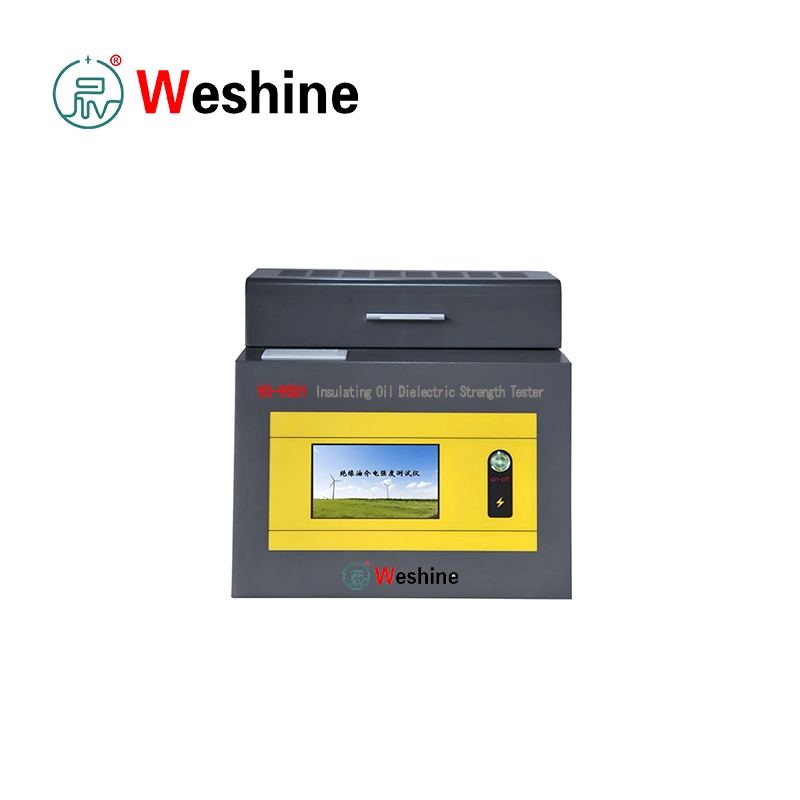
Insulating Oil Dielectric Strength Tester & Breakdown Voltage (BDV) Test Sets
The dielectric breakdown voltage (BDV) of insulating oil is a primary indicator of its ability to withstand high electrical stress without electrical sparkover. Over time, moisture absorption, free carbon, sediment, and chemical oxidation degrade the oil's dielectric withstand capability, increasing the risk of catastrophic flashover and failure inside transformers, circuit breakers, and high-voltage bushings.
As a trusted manufacturer of power system diagnostic equipment, Weshine Electric provides high-precision insulation oil dielectric test sets. Featuring fully automated high-voltage ramp sequences, precise digital measurement, and built-in international standards, our instruments deliver fast, dependable, and reproducible results for field substations and analytical laboratories worldwide.
Applications of Insulating Oil Dielectric Strength Testers
Power Utilities & High-Voltage Substations
-
Routine Substation Maintenance: Fast field testing of oil breakdown voltage during scheduled transformer inspection cycles.
-
Condition-Based Asset Assessment: Tracking breakdown voltage levels to determine when vacuum filtration, degasification, or oil replacement is necessary.
-
Emergency Commissioning Checks: Verifying dielectric withstand limits before re-energizing serviced or newly filled transformers.
Transformer Manufacturing & Factory Acceptance Testing (FAT)
-
Quality Assurance Audits: Verifying that refined mineral oil, synthetic ester, or silicone fluid meets initial factory specification limits prior to vessel filling.
-
Production Line Quality Control: Testing oil samples directly from storage tanks, tankers, or vacuum oil purification lines.
Oil Testing Laboratories & Inspection Agencies
-
Standardized High-Voltage Testing: Executing automated BDV test sequences according to international standard electrode gaps and voltage rise rates.
-
Commercial Oil Quality Certification: Generating accurate, verifiable test reports for utility clients and industrial plant owners.
Featured Dielectric Strength Testing Products
Explore our flagship breakdown voltage testing equipment designed for precise, automated insulation health evaluation:
80kV Insulating Oil Dielectric Strength Tester
Designed for high-precision breakdown voltage measurement up to 80 kV AC. Features automated voltage boosting, micro-processor control, magnetic stirring, built-in printer, and standard compliance selection.
-
Output Voltage: 0 to 80 kV AC (Smooth, automated voltage ramp rates)
-
Explore Product: View 80kV Insulating Oil Dielectric Strength Tester Details
Technical Importance of Breakdown Voltage (BDV) Testing
Dielectric strength testing measures the maximum electric field that insulating liquid can withstand before sparkover breakdown occurs:
| Diagnostic Target | Impact of Degradation on BDV |
| Moisture Contamination | Suspended water droplets drastically reduce breakdown voltage, causing premature dielectric breakdown. |
| Particulate & Fiber Contamination | Solid particulates align along electric field lines, forming conductive bridges that trigger sparkover. |
| Chemical Oxidation & Aging | Polar aging products and sludge accumulation impair overall electrical withstand strength. |
Utilizing an automatic insulation oil dielectric test set eliminates manual operator bias, providing consistent voltage ramp speeds (e.g., 2.0 kV/s or 3.0 kV/s) and instant breakdown arc quenching within microseconds to prevent oil carbonization during testing.
Advanced Features and Technology
Precise High-Voltage Generation & Rapid Arc Cut-off
Utilizes advanced high-voltage control technology to deliver smooth, distortion-free sine-wave AC voltage ramps. When dielectric breakdown occurs, high-speed electronic protection cuts off the voltage within 10 microseconds to protect the oil sample from severe burning or carbonization.
Pre-Programmed International Testing Standards
Equipped with built-in standard test protocols (IEC 60156, ASTM D1816, ASTM D877, etc.). Users can simply select the desired standard, and the instrument automatically handles stir times, wait intervals, voltage ramp speeds, and average BDV calculations.
Comprehensive Safety Protection & User Interface
Features complete safety interlocks (auto power-off when lid is raised), high-voltage grounding protection, digital LCD screens, built-in thermal printing, and USB output options for seamless digital report management.
Key Advantages of Weshine BDV Testers
-
High Measurement Precision: Microprocessor-controlled high-voltage measurement ensures exceptional accuracy (±1% accuracy across full scale).
-
Fully Automated Workflows: One-touch operation with automated stirring, resting, voltage ramping, arc quenching, and statistical calculation.
-
Interchangeable Test Cells & Electrodes: Supports standardized electrode configurations including spherical, flat dish, and VDE electrodes with adjustable gap gauges.
-
Portable & Robust Design: Engineered for dual-use versatility, operating reliably on lab benches or directly in harsh substation field environments.
International Dielectric Strength Testing Standards
| Standard | Electrode Type | Gap Distance | Voltage Ramp Rate |
| IEC 60156 | Spherical or VDE | 2.5 mm | 2.0 kV/s ± 0.2 kV/s |
| ASTM D1816 | VDE (Spherical Cap) | 1.0 mm / 2.0 mm | 0.5 kV/s |
| ASTM D877 | Flat Disc | 2.54 mm | 3.0 kV/s |
How to Choose the Right Insulation Oil Dielectric Test Set
When selecting an insulating oil dielectric strength tester, consider these critical requirements:
-
Voltage Range Selection: Ensure maximum output voltage matches your equipment ratings (e.g., 80 kV for standard transmission transformers, 100 kV for ultra-high-voltage systems).
-
Electrode Compatibility: Select test cells that easily accommodate IEC 60156 (spherical/VDE) or ASTM D1816 gap configurations.
-
Safety Interlocks: High-voltage laboratory safety requires zero-voltage start protection and physical lid interlocks.
Why Choose Weshine Electric
Technical Capabilities & Quality Manufacturing
Weshine Electric specializes in high-voltage testing and dielectric analysis equipment. Every insulating oil dielectric strength tester undergoes multi-point high-voltage calibration against traceable standards prior to dispatch.
Complete Transformer Oil Testing Fleet
We offer end-to-end diagnostic solutions ranging from breakdown voltage testers and Karl Fischer moisture titrators to DGA gas chromatographs and vacuum oil purification machines.
Global B2B Support & Customization
We serve global utilities, transformer manufacturers, and industrial service companies with direct technical consultation, factory pricing, calibration services, and OEM/ODM options.
Related Products & Category Links
Explore complementary oil diagnostic products from our catalog:
-
80kV Insulating Oil Dielectric Strength Tester — High-precision automatic 80kV BDV testing instrument.
-
Insulating Oil Tester — Explore our full catalog of dielectric breakdown, trace moisture, and oil purification tools.
Frequently Asked Questions
Q1: What is breakdown voltage (BDV) in transformer oil testing?
Breakdown voltage (BDV) is the minimum AC voltage at which insulating oil suffers electrical breakdown. A higher BDV indicates cleaner, drier oil with good dielectric insulating properties, while a low BDV signals water contamination, sludge, or particulate pollution.
Q2: What is a normal or acceptable BDV value for transformer oil?
For new, processed mineral oil in high-voltage transformers, BDV should typically exceed 50 kV to 60 kV (over a 2.5 mm gap according to IEC 60156). For in-service oil, action is generally required if BDV drops below 30 kV to 40 kV depending on the voltage class.
Q3: Why is automated stirring important during dielectric strength testing?
Stirring between voltage ramps ensures homogeneous distribution of potential contaminants and clears gas bubbles formed by previous arcing breakdowns, preventing artificially low readings on subsequent tests.
Q4: How often should an insulating oil dielectric strength tester be calibrated?
Annual calibration is recommended to ensure that high-voltage output transformers, voltage dividers, and ramp-rate timers maintain accurate, standard-compliant performance.