








Ultra-Low Frequency Portable VLF Hipot Tester | VS-CDP
Products Details
Portable VLF Hipot Tester (Ultra-Low Frequency High Voltage Generator) is designed for AC withstand testing of electrical insulation where conventional power-frequency test equipment would require excessive capacity. In preventive insulation maintenance, high-voltage withstand testing is a crucial method for verifying whether equipment insulation can safely withstand specified operating voltages. For large-capacitance test objects such as XLPE power cables, power capacitors, large generators, and motors, 50 Hz AC testing often demands massive power transformers or resonant test sets. Utilizing a 0.1 Hz ultra-low frequency test system drastically reduces the required test power capacity, making field testing far more practical.
The system generates a controlled ultra-low frequency AC high-voltage output with selectable operating frequencies of 0.1 Hz, 0.05 Hz, 0.02 Hz, and 0.01 Hz. The lower frequencies allow the instrument to test significantly larger capacitive loads while maintaining a compact equipment size and manageable power demand. According to operational guidelines, the system is particularly suitable for electrical equipment with large equivalent capacitance, including power cables, capacitors, and medium-to-large generators or motors.
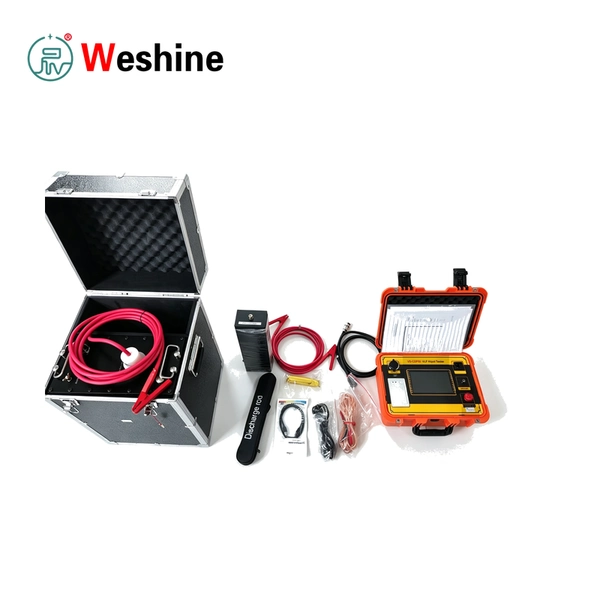
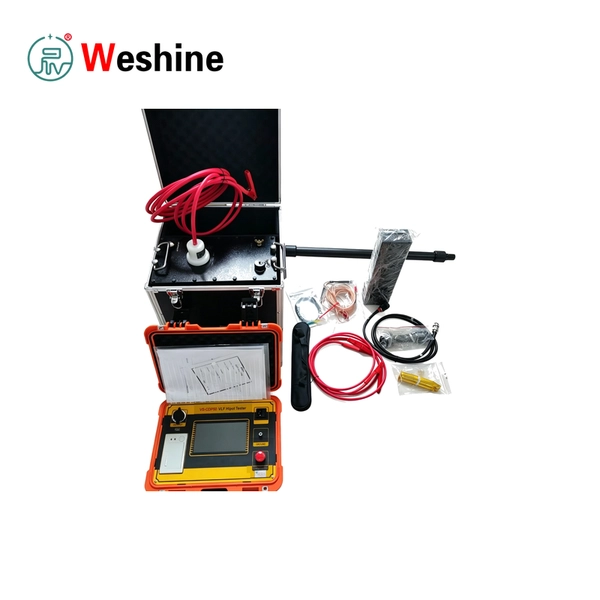
Built for field mobility, this system consists of two primary units: a main controller and a high-voltage booster. The controller features a 7-inch capacitive touchscreen, power switch, AC 220 V power input, grounding terminal, USB communication port, built-in printer, and emergency stop button. The high-voltage booster unit produces the high-voltage output and connects to the controller via a supplied low-voltage control cable. High-voltage output is applied to the test object using dedicated high-voltage cabling and grounding accessories.
Operation is fully automated. After wiring, operators set the output frequency, test duration, test voltage, and both high-voltage side and low-voltage side overcurrent/overvoltage limits directly on the touchscreen. Once started, the instrument automatically performs load self-checking, voltage ramping, constant-amplitude output holding, timing, shutdown, and post-test discharge. The test can conclude automatically via the built-in timer or manually. It also incorporates abnormal shutdown protection triggered by overvoltage or overcurrent events.
As an advanced solution in modern Electrical Test Equipment, the unit employs closed-loop high-voltage and low-voltage negative feedback control, ensuring the output is free from capacitive rise effects. Comprehensive protection functions include overvoltage protection as well as high-voltage and low-voltage side overcurrent protection, with an ultra-fast reaction time under 10 ms. The controller and high-voltage generator communicate via low-voltage control, utilizing optical isolation for enhanced operator safety.
Test results can be printed directly as physical test reports via the integrated printer. Historical data is saved automatically following normal timer stops, manual stops, or protection shutdowns. As a reliable VLF Hipot Tester, the system stores up to 64 measurement records, with older entries automatically overwritten when the memory limit is reached. Additional features include date and time configuration, Chinese and English interface switching, automatic data logging, auto-printing, and USB communication with management PC software.
The generator complies with DL/T 849.4-2004 (General Technical Conditions for Ultra-Low Frequency High Voltage Generators) and references standard 0.1 Hz VLF testing methods for 35 kV and below XLPE insulated power cables. During field application, the test object capacitance must not exceed the rated capacitive load of the selected system configuration. If the load capacitance is below 0.05 μF, an auxiliary 0.05 μF compensation capacitor can be connected in parallel to maintain normal waveform output.
System Specifications
General Technical Specifications
| Item | Specification |
| Product type | Ultra-low frequency high voltage generator |
| Output waveform | Ultra-low frequency AC high voltage |
| Output frequencies | 0.1 Hz, 0.05 Hz, 0.02 Hz, 0.01 Hz |
| Measurement accuracy | 3% |
| Peak voltage error | Positive and negative peak voltage error ≤ 3% |
| Voltage waveform distortion | ≤ 5% |
| Operation mode | Automatic voltage rise, timing, shutdown, and discharge |
| Display | 7-inch capacitive touchscreen |
| Data storage | Up to 64 historical test records |
| Printing | Integrated thermal printer |
| Communication | USB interface |
| Applicable standard | DL/T 849.4-2004 |
Load Capacity
| Output Frequency | Maximum Capacitive Load |
| 0.1 Hz | 0.5 μF |
| 0.05 Hz | 1.1 μF |
| 0.02 Hz | 2.2 μF |
| 0.01 Hz | 5.5 μF |
Series Rating Options
| Model Rating | Rated Output Voltage | Load Capacity | Power Fuse | Structure / Weight |
| 30/1.1 | 30 kV peak | 0.1 Hz ≤0.5 μF; 0.05 Hz ≤1.1 μF; 0.02 Hz ≤2.2 μF; 0.01 Hz ≤5.5 μF | 10 A | Controller: 4 kg; Booster: 20 kg |
| 40/1.1 | 40 kV peak | 0.1 Hz ≤0.5 μF; 0.05 Hz ≤1.1 μF; 0.02 Hz ≤2.2 μF; 0.01 Hz ≤5.5 μF | 10 A | Controller: 4 kg; Booster: 20 kg |
| 50/1.1 | 50 kV peak | 0.1 Hz ≤0.5 μF; 0.05 Hz ≤1.1 μF; 0.02 Hz ≤2.2 μF; 0.01 Hz ≤5.5 μF | 15 A | Controller: 4 kg; Booster: 40 kg |
| 60/1.1 | 60 kV peak | 0.1 Hz ≤0.5 μF; 0.05 Hz ≤1.1 μF; 0.02 Hz ≤2.2 μF; 0.01 Hz ≤5.5 μF | 15 A | Controller: 4 kg; Booster: 50 kg |
| 80/1.1 | 80 kV peak | 0.1 Hz ≤0.5 μF; 0.05 Hz ≤1.1 μF; 0.02 Hz ≤2.2 μF; 0.01 Hz ≤5.5 μF | 15 A | Controller: 4 kg; Booster: 50 kg |
| 90/1.1 | 90 kV peak | 0.1 Hz ≤0.5 μF; 0.05 Hz ≤1.1 μF; 0.02 Hz ≤2.2 μF; 0.01 Hz ≤5.5 μF | 15 A | Controller: 4 kg; Booster: 55 kg |
Power Supply Requirements
| Item | Specification |
| Input voltage | 220 V ± 5% AC |
| Input frequency | 50 Hz ± 5 Hz |
| Portable generator requirement | Stable 220 V ± 5%, 50 Hz; rating generally > 3 kW |
Protection Functions
| Protection Item | Specification |
| Overvoltage protection | User-configurable limit (0 to rated value) |
| Overcurrent protection | User-configurable limit (0 to rated value) |
| Protection action time | ≤ 10 ms |
| Emergency control | Emergency STOP button on controller |
| Automatic discharge | Executed automatically after high-voltage shutdown |
Environmental & Storage Conditions
| Parameter | Operating Condition | Storage Condition |
| Environment | Indoor and outdoor | Ventilated indoor area (no corrosive gas) |
| Temperature | -10°C to +40°C | -20°C to +60°C |
| Humidity | ≤ 85% RH | ≤ 85% RH |
Standard Accessories
| No. | Item | Quantity |
| 1 | Main Controller | 1 Set |
| 2 | High-Voltage Booster | 1 Set |
| 3 | High-Voltage Connecting Cables | 2 Pcs |
| 4 | Low-Voltage Control Cable | 1 Pc |
| 5 | Main Power Cable | 1 Pc |
| 6 | Discharge Rod | 1 Pc |
| 7 | Grounding Cable | 1 Pc |
| 8 | Compensation Capacitor | 1 Pc |
| 9 | Fuses | 5 Pcs |
| 10 | Thermal Printer Paper | 2 Rolls |
| 11 | User Manual | 1 Copy |
| 12 | Packing List | 1 Copy |
| 13 | Factory Inspection Report | 1 Copy |
How the System Works
The Portable VLF Hipot Tester substitutes power-frequency (50 Hz) withstand testing with ultra-low frequency AC voltage testing. For capacitive objects, test current is directly proportional to frequency, capacitance, and voltage. By dropping the operating frequency to 0.1 Hz or lower, required test capacity is drastically reduced while retaining the diagnostic validity of AC insulation testing.
Before testing, connect the controller, booster unit, high-voltage lead, grounding cable, and test object following the wiring diagram. The grounding terminal must be solidly grounded to earth. Connect the system to a 220 V, 50 Hz power source (or a stable portable generator).
Power on the controller to enter parameter setup. Input output frequency, test duration (0 to 99 min), test voltage, overvoltage limit, and overcurrent limit. Selectable frequencies include 0.1 Hz, 0.05 Hz, 0.02 Hz, and 0.01 Hz. Voltage and current readings are displayed as peak values.
Press Start to run an automatic self-check. If no capacitive load is detected, a no-load warning appears. Upon passing self-check, the instrument automatically ramps up voltage, maintains constant amplitude upon reaching set limits, and tracks elapsed time. When the timer expires, the high-voltage output cuts off and the internal discharge system activates.
The unit supports both automatic timed shutdown and manual stop, as well as automatic tripping under overvoltage or overcurrent conditions. All test data is stored automatically upon test conclusion. Operators can review past logs and print reports directly on site.
For cable testing, completely disconnect all connected terminal equipment and perform insulation resistance verification with a megohmmeter first. Set the test voltage according to guidelines (Umax = 3U₀, where U₀ is cable rated phase voltage). Test duration is typically 60 minutes for commissioning/handover tests and 15 minutes for preventive maintenance.
For synchronous motors, test phase-by-phase with non-tested phases shorted and grounded. Test duration is typically 1 minute. Operators should monitor for abnormal sound, odor, smoke, flashover, or current instability during the test.
After shutdown, always use the discharge rod to fully discharge the test object prior to disconnecting any leads.
Features
- Supports 0.1 Hz ultra-low frequency AC withstand testing.
- Supports 0.05 Hz, 0.02 Hz, and 0.01 Hz output frequency selection.
- Provides automatic voltage rise, constant-amplitude output, timing, shutdown, and discharge.
- Measures and displays high-voltage output and test current as peak values.
- Provides overvoltage protection for the high-voltage output.
- Provides high-voltage side and low-voltage side overcurrent protection.
- Automatically cuts off output when voltage or current exceeds the set limit.
- Protection action time not more than 10 ms.
- Provides 7-inch capacitive touch screen operation.
- Displays test data and output waveform on the touch screen.
- Includes automatic historical data storage for up to 64 records.
- Provides built-in printer for test report printing.
- Supports USB communication with upper management software.
- Includes Chinese and English interface switching.
- Provides closed-loop high-voltage and low-voltage negative feedback control.
- Supports AC withstand testing of large-capacitance test objects.
- Includes discharge rod and grounding cable for safe post-test discharge.
- Provides emergency stop button on the controller.
- Supports indoor and outdoor operation.
- Includes compensation capacitor for small-capacitance test objects.
Application Scenarios
-
Power Utilities: VLF withstand testing of medium-voltage power cables, large motors, generators, capacitors, and substation equipment during commissioning and routine maintenance.
-
Transformer Manufacturers: Quality assurance and insulation verification for capacitive components requiring AC withstand testing.
-
Power Plants: Stator winding testing for generators, station service cable maintenance, and auxiliary system testing during scheduled overhauls.
-
Railways: Maintenance testing of traction substation cables and rotating electrical equipment.
-
Industrial Plants: Insulation verification for cable distribution networks and large motors in petrochemical, mining, and manufacturing facilities.
-
Universities & Research: Field-demonstration and teaching of VLF withstand principles, capacitive load dynamics, and high-voltage safety.
-
Testing Laboratories: Testing services for large capacitive loads, motor coils, and cable samples requiring controlled ultra-low frequency testing.
-
Cable Maintenance Teams: Commissioning, preventive checks, and post-repair insulation verification for XLPE cable installations.
Applications
- 0.1 Hz VLF AC withstand testing.
- XLPE power cable withstand testing.
- 35 kV and below cable insulation testing.
- Power capacitor withstand testing.
- Medium and large generator insulation testing.
- Motor stator winding withstand testing.
- Cable handover testing.
- Cable preventive maintenance testing.
- Large-capacitance equipment insulation verification.
- Field AC withstand testing with reduced test power capacity.
- Automatic timed high-voltage testing.
- Overvoltage and overcurrent protected withstand testing.
- Historical test record storage.
- Printed test report generation.
- Insulation condition screening before energization.
Customer Case
-
Industry: Cable maintenance contractor
-
Problem: A contractor needed to execute field acceptance testing on a newly installed medium-voltage XLPE cable line. Conventional 50 Hz power-frequency equipment was too bulky to transport and required excessive input power due to high cable capacitance.
-
Testing Process: Technicians isolated the cable, verified insulation resistance with a megohmmeter, and wired the controller, booster, high-voltage lead, grounding cable, and discharge rod. They selected 0.1 Hz output, configured the test voltage based on phase rating, set the overcurrent threshold, and initiated automatic testing.
-
Result: The system executed smooth voltage ramping, maintained target voltage for the timed duration, shut down cleanly, and discharged the cable. No breakdown, current spikes, or tracking occurred. Test data was printed immediately for the field log.
-
Benefits: The contractor completed the job using a compact, lightweight system that drastically reduced power requirements on site while maintaining complete testing compliance and field traceability.
FAQ
-
What is the primary function of the Portable VLF Hipot Tester?
It is used for VLF AC withstand testing on large-capacitance electrical assets, including medium-voltage cables, generators, motors, and power capacitors.
-
Why choose 0.1 Hz VLF over 50 Hz AC testing?
Capacitive loads demand high current at 50 Hz, necessitating massive test equipment. Reducing frequency to 0.1 Hz lowers current demand proportionately, allowing lightweight, portable equipment to perform the test.
-
What frequencies are available on this model?
The system supports 0.1 Hz, 0.05 Hz, 0.02 Hz, and 0.01 Hz.
-
What is the maximum capacitive load capacity?
Max load is 0.5 μF at 0.1 Hz, 1.1 μF at 0.05 Hz, 2.2 μF at 0.02 Hz, and 5.5 μF at 0.01 Hz.
-
What protection mechanisms are built into the unit?
It includes dual-side overcurrent protection, overvoltage protection, emergency stop, and automatic post-test capacitive discharge (< 10 ms trip time).
-
Does it support direct report printing?
Yes, an integrated thermal printer allows operators to print test data and history records directly in the field.
-
How many test logs can be saved in memory?
The controller stores up to 64 historical records internally.
-
What post-test safety step is mandatory?
Always use the included discharge rod to fully discharge the test object to ground before touching or removing any test leads.
Weshine Advantages
Weshine Electric provides electrical testing equipment for power utilities, contractors, industrial plants, laboratories, and cable maintenance teams. For VLF withstand testing, Weshine focuses on practical field operation, stable high-voltage output, automatic protection, complete accessories, and clear test documentation. Instruments are supplied with factory inspection records and operation guidance to support reliable use after delivery. Weshine can assist customers with model selection, cable test voltage setting, load capacitance evaluation, and customized testing requirements. With engineering experience, quality control, technical support, reliable testing solutions, and international service, Weshine helps users perform cable and large-capacitance insulation testing efficiently and safely.