






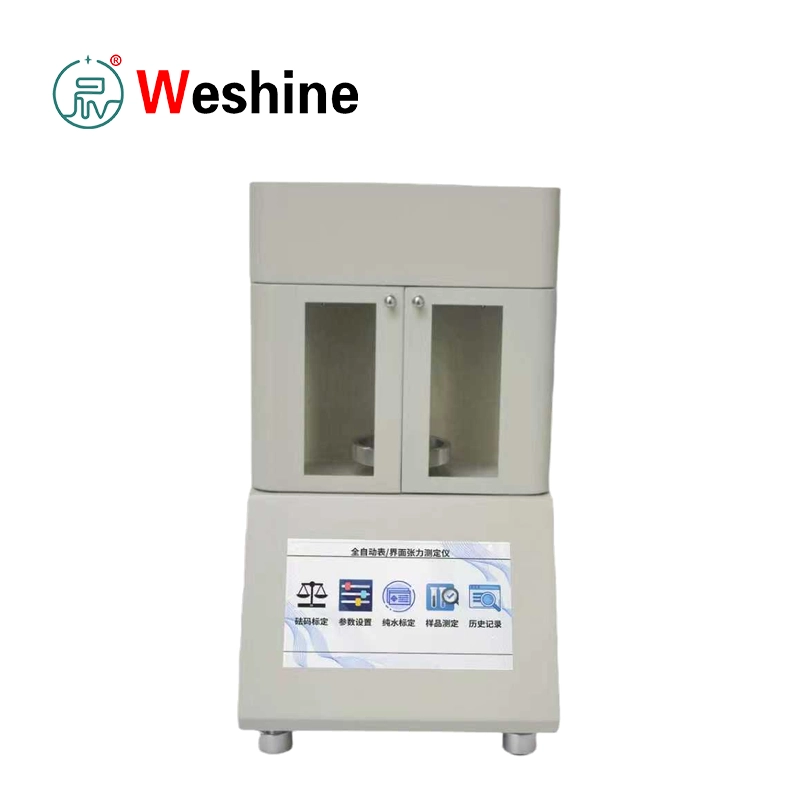


Automatic Oil Interfacial Tension Tester | VS-9804
Products Details
Interfacial tension is an important physical property in oil testing. For transformer oil and other insulating oils, a lower oil-water interfacial tension value may indicate oxidation products, polar contaminants, aging by-products, or dissolved impurities. Because these changes may affect insulation condition and oil service life, interfacial tension measurement is often used together with dielectric strength, moisture, acid value, and dissolved gas analysis in oil condition assessment.
The VS-9804 Automatic Oil Interfacial Tension Tester is developed for measuring surface and interfacial tension under non-equilibrium conditions. It can be used for liquid-gas surface tension and liquid-liquid interfacial tension measurement. The instrument is suitable for petroleum, chemical, power, pharmaceutical, and liquid product testing applications.
The instrument uses the platinum ring method. A platinum wire ring is placed at the liquid interface, and the instrument measures the force required to detach the ring from the liquid surface. The system then calculates the corresponding tension value according to the ring dimensions, liquid density, and correction factor. This method is widely used for oil-water interfacial tension measurement.
The VS-9804 uses an improved sealed electromagnetic force balance sensor. This sensor structure helps improve response speed and linearity, and the manual states that the new sensor only requires one-point calibration. The internal microprocessor can also perform two-way temperature compensation based on 25°C, helping adapt measurement results to common laboratory temperature conditions.
The instrument provides bilingual Chinese and English operation options. Users can set light liquid density, heavy liquid density, platinum wire radius, platinum ring radius, working temperature, print option, date and time, and automatic temperature measurement and compensation. Test records can be printed directly, and data can be uploaded through the RS232 interface.
Specification
| Technical Parameters | |
| Item | Specification |
| Product model | VS-9804 |
| Product type | Automatic Oil Interfacial Tension Tester |
| Reference standard stated in manual | GB/T 6541 |
| Measurement principle | Platinum ring method |
| Measurement range | 5 to 200 mN/m |
| Sensitivity | 0.1 mN/m |
| Accuracy | ±0.1 mN/m |
| Resolution | 0.01 mN/m |
| Applicable temperature | 10°C to 40°C |
| Applicable humidity | 20% to 75% RH |
| Automatic temperature acquisition range | 10°C to 40°C |
| Temperature compensation reference | 25°C |
| Power supply | AC 220 V ±5%, 50 Hz |
| Power consumption | 20 W |
| Data interface | RS232 |
| Serial communication setting | 19200 baud, 8 data bits, 1 start bit, 1 stop bit, no parity |
| Printer | Built-in printer |
| Dimensions | 185 mm × 260 mm × 360 mm |
| Weight | About 15 kg |
Product Guide
Before measurement, place the VS-9804 on a stable indoor workbench without direct sunlight, vibration, dust, corrosive gas, high temperature, or airflow disturbance. The instrument should be leveled using the adjustable feet so that the level bubble is centered. Proper leveling is important because the platinum ring method depends on stable force measurement.
Install the platinum ring carefully. The platinum ring should be removed from its storage box gently to avoid deformation. Connect the ring to the hanging rod, install the magnetic hanging rod into the balance rod position, and confirm that it does not touch the coil wall. A deformed or contaminated platinum ring can directly affect measurement accuracy.
Before sample testing, enter the parameter setting interface. Set the light liquid density, heavy liquid density, platinum wire radius, platinum ring radius, working temperature, print option, date and time. If automatic temperature measurement is selected, the instrument can acquire temperature and apply compensation; otherwise, the working temperature should be entered manually.
Calibration should be completed when required. The instrument supports weight calibration and pure water calibration. For pure water calibration, clean the platinum ring and test cup thoroughly, place the test cup on the cup holder, add purified water to the lower scale mark, and start the calibration from the screen. If pure water calibration fails, check whether weight calibration has been performed, whether the ring and cup are clean, and whether the laboratory temperature is suitable.
For sample testing, clean the platinum ring and test cup first. Add purified water to the lower mark of the test cup and start the sample measurement function. When the instrument prompts for sample addition, add the tested oil sample to the upper scale mark and continue the test. The instrument completes the measurement and calculates the tension value automatically.
After measurement, users can enter the historical record interface. The latest result is displayed as the first record, and previous records can be reviewed through page navigation. The selected record can be printed, and data can be uploaded to a computer through the RS232 interface.
Features
- Supports oil-water interfacial tension testing based on GB/T 6541.
- Measures liquid-gas surface tension and liquid-liquid interfacial tension.
- Uses the platinum ring method for tension measurement.
- Automatically calculates interfacial tension and surface tension values.
- Provides Chinese and English bilingual operation options.
- Includes improved sealed electromagnetic force balance sensor.
- Supports one-point calibration according to the manual.
- Provides automatic temperature acquisition from 10°C to 40°C.
- Automatically performs temperature compensation based on 25°C.
- Supports parameter setting for liquid density, ring radius, wire radius, working temperature, date, and time.
- Includes pure water calibration and weight calibration functions.
- Provides built-in printing for test records.
- Supports RS232 data upload to a computer.
- Includes LCD display, sample cup, platinum ring, sample tray, printer, and data interface.
Application Scenarios
The VS-9804 is suitable for transformer oil laboratories that need to evaluate oil-water interfacial tension as part of insulating oil condition monitoring. A decrease in interfacial tension can help indicate oil aging or contamination, especially when reviewed together with acid value, dielectric strength, moisture, and dissolved gas analysis.
In power utilities and substations, the instrument can support routine oil testing programs for transformers, reactors, oil-filled circuit breakers, and other oil-filled electrical equipment. Test results help maintenance engineers track oil condition and plan oil treatment or replacement.
In petroleum and chemical laboratories, the VS-9804 can be used for liquid surface tension and liquid-liquid interfacial tension analysis. It is suitable for evaluating petroleum products, chemical liquids, additives, and formulations where surface-active substances influence product performance.
In pharmaceutical and industrial liquid testing, the instrument can support laboratory quality control where liquid surface properties need to be measured under controlled conditions. The automatic calculation and printing functions help keep the testing workflow clear and traceable.
Applications
The VS-9804 Automatic Oil Interfacial Tension Tester is used by power utilities, transformer oil testing laboratories, petroleum companies, chemical plants, industrial quality control departments, research institutes, pharmaceutical liquid laboratories, and third-party testing organizations.
Typical samples include transformer oil, insulating oil, turbine oil, petroleum products, chemical liquids, oil-water systems, and other liquid samples suitable for platinum ring surface or interfacial tension measurement.
For international B2B and SEO use, the VS-9804 can be described as an automatic oil interfacial tension tester, transformer oil interfacial tension meter, oil-water interfacial tension analyzer, platinum ring tensiometer, surface tension tester, and insulating oil tension measurement instrument.
Customer Case
A transformer oil testing laboratory used interfacial tension as one of its routine indicators for oil condition evaluation. The laboratory tested oil samples from several substations and compared interfacial tension values with acid value, moisture, and dielectric strength results.
The team used the VS-9804 to measure oil-water interfacial tension. Before testing, the technician leveled the instrument, cleaned the platinum ring and sample cup, performed calibration, entered the liquid density and working temperature parameters, and started the sample test. The instrument automatically calculated the interfacial tension value and printed the result for the laboratory record.
One transformer oil sample showed a noticeably lower interfacial tension value than previous records. Combined with rising acid value, the result suggested oil aging and contamination. The maintenance team scheduled further inspection and oil treatment planning instead of relying on a single test item.
By using the VS-9804, the laboratory improved the consistency of oil interfacial tension measurement and kept traceable printed records for transformer maintenance decisions.
FAQ
- What is the VS-9806A used for?
It is used to measure the open cup flash point of petroleum products and oil samples, helping users evaluate volatility, safety, and oil quality. - What standards does it follow?
The manual states that the instrument meets the method requirements of GB/T 3536-2008 and GB/T 267-88. - What is the measurement range?
The measurement range is 40°C to 400°C. - Does it use gas ignition?
No. The VS-9806A uses electric ignition and does not require combustible gas. - Can it correct atmospheric pressure influence?
Yes. It automatically detects atmospheric pressure and corrects the test result. - How many records can it store?
The instrument can store up to 1000 measurement results. - Does it include printing?
Yes. It includes a dot-matrix thermal printer for test record output. - What should be avoided during operation?
Avoid strong air flow, direct sunlight, forcing the lifting or sweep mechanism by hand, and testing with a dirty open cup or contaminated flash sensor. - What power supply is required?
The instrument uses AC 220 V ±11 V, 50 Hz ±2.5 Hz. - Where is this tester commonly used?
It is commonly used in petroleum, power, chemical, commodity inspection, industrial maintenance, and laboratory testing applications.
Weshine Advantages
Weshine Electric provides oil testing and electrical diagnostic instruments for utilities, substations, laboratories, petroleum users, industrial plants, and inspection service providers. For the VS-9806A Automatic Open Flash Point Tester, Weshine supports customers with model selection, technical parameter confirmation, operation guidance, documentation, and after-sales service.
The VS-9806A helps users complete open cup flash point testing with automatic heating control, electric ignition, pressure correction, result storage, printing, and forced cooling. It is suitable for customers who need a practical automatic open flash point analyzer for petroleum products, transformer oil, insulating oil, and industrial oil testing.