






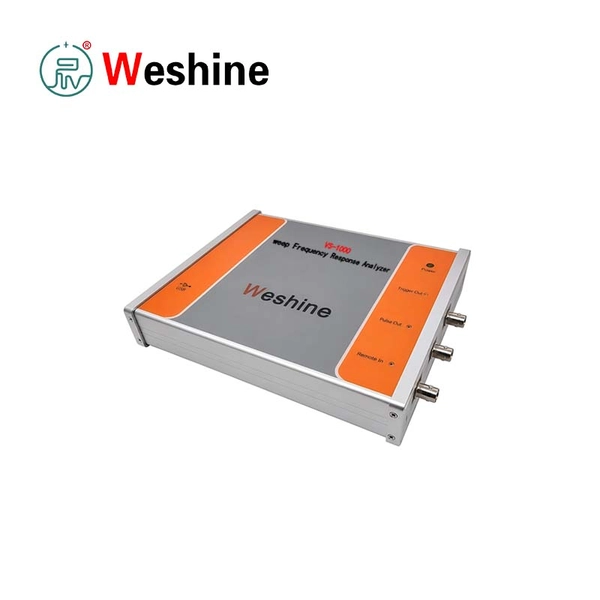


Sweep Frequency Response Analyzer | VS-1000
Products Details
VS-1000 Sweep Frequency Response Analyzer is specifically engineered for non-intrusive transformer winding deformation testing using the advanced sweep frequency response analysis (SFRA) method.
Power transformers routinely encounter significant mechanical and electrodynamic stress during transportation, installation, long-term operation, severe short-circuit faults, or external impacts. Under high electrodynamic forces, internal winding structures can suffer from displacement, distortion, loosening, swelling, or localized mechanical deformation. These structural alterations compromise internal insulation clearances, reduce short-circuit withstand capacity, and risk catastrophic transformer failure.
Diagnostic Principle
The VS-1000 detects internal winding deformation by measuring and analyzing the amplitude-frequency response characteristics of each transformer winding. During diagnostic testing, the analyzer injects a continuous sweep frequency AC signal into one terminal of the winding and records the corresponding response signal at the other.
The transformer winding, magnetic core, insulation medium, clamping structure, and inter-turn distributed capacitance collectively form a complex, frequency-dependent electrical network. Any physical shift in winding geometry or internal clamping pressure alters this distributed R-L-C network, causing measurable shifts in the frequency response curve. By comparing these response curves vertically (across phases) or horizontally (against historical factory baseline data), field engineers can accurately detect early-stage mechanical winding integrity issues.
Field-Proven Performance & Convenience
-
Non-Intrusive Diagnostics: Applicable to power transformers rated at 66 kV and above, as well as special-purpose industrial transformers. Diagnostic evaluation requires no tank opening or internal dismantling, making it an essential tool following transport, short-circuit trip events, major overhauls, or abnormal operations.
-
High-Precision Signal Generation: Utilizes direct digital frequency synthesis (DDS) to deliver ultra-stable output across a sweep range of 10 Hz to 2 MHz with a frequency accuracy superior to ±0.001%.
-
Wide Dynamic Range: Features a broad dynamic measurement range of -100 dB to 20 dB, allowing the analyzer to capture minute winding response variations across high and low signal levels.
-
Rapid Field Testing: Single-phase winding measurements take only 1 to 2 minutes. The intelligent software platform enables one-click automated testing after basic wiring setup.
Technical Specifications
| System Specifications | |
| Item | Specification |
| Product model | VS-1000 |
| Product type | Sweep frequency response analyzer |
| Test method | Frequency response analysis |
| Applicable equipment | Power transformers of 66 kV and above; special-purpose transformers |
| Curve display | Amplitude-frequency curve |
| Software platform | Windows 2000 / Windows XP / Windows 7 / Windows 8 / Windows 10 / Windows 11 |
| Data management | Database storage |
| Report output | Word test report or JPG report |
| Simultaneous curve loading | Up to 9 curves |
| Voltage isolation | 5000 V |
| Measurement Specifications | |
| Item | Specification |
| Measuring speed | 1 to 2 minutes for single-phase winding |
| Output voltage | Automatically adjusted during test |
| Output impedance | 50 Ω |
| Input impedance | 1 MΩ |
| Response channel matching resistance | Built-in 50 Ω matching resistance |
| Frequency sweep range | 10 Hz to 2 MHz |
| Frequency accuracy | 0.00% |
| Frequency sweep mode | Linear or logarithmic |
| Sweep interval | Freely settable |
| Number of sweep points | Freely settable |
| Measuring dynamic range | -100 dB to 20 dB |
| Power Supply And Physical Data | |
| Item | Specification |
| Supply voltage | AC 100 to 240 V, 50/60 Hz |
| Recommended adapter | DC 12 V adapter |
| Dimension stated in manual | 40 mm |
| Net weight | 2.45 kg |
| Applicable Standards | |
| Standard | Description |
| DL/T 911-2016 | Transformer winding deformation test by frequency response analysis |
| IEC 60076-18 | Power transformers, measurement of frequency response |
| Software Functions | |
| Function | Description |
| Curve comparison | Supports vertical and horizontal comparison of winding response curves |
| Parameter calculation | Automatically calculates parameters of each loaded curve |
| Reference diagnosis | Provides reference conclusion for winding deformation analysis |
| Data saving | Automatically saves measurement data |
| Report export | Exports Word report or JPG report |
| Operation mode | One-click measurement after parameter setting |
| Test condition setup | Mostly selectable options to reduce manual input |
Product Guide & Testing Procedure
Operating Principle
The VS-1000 measures the electrical network transfer function of a transformer winding. Because winding geometry directly governs distributed inductance and capacitance, any physical deformation shifts the resonant peak frequencies and amplitude levels across the 10 Hz to 2 MHz spectrum.
Pre-Test Field Preparation
-
Safety Disconnection: Disconnect all external transformer leads (overhead lines, enclosed busbars, and high-voltage cables). Keep disconnected conductors at least 20 cm away from the bushing terminals.
-
Terminal Discharge: Fully discharge all transformer winding terminals to ground prior to making test connections.
-
Tap Changer Position: Record the exact tap changer position. For on-load tap changers (OLTC), place the tap at Tap 1 (or the maximum turns position) for maximum winding exposure. For off-circuit tap changers, ensure all phase tests are conducted at identical tap positions.
-
Grounding Integrity: Reliably ground the transformer tank and core. Ensure the VS-1000 main enclosure and measuring impedance units share a common earth ground with the transformer tank.
-
Contact Cleaning: Ensure measuring impedance clamps make tight, low-resistance metallic contact with the bushing terminals. Remove oxide layers, rust, or grease using abrasive cloth.
Execution & Analysis
-
Connect excitation and response leads according to the selected winding wiring configuration (keep non-tested windings suspended as specified).
-
Launch the software, input transformer nameplate information, set frequency sweep parameters, and initiate automated acquisition.
-
Upon completing all phase measurements, use the software's curve overlay tool to evaluate correlation parameters, generate diagnostic reports, and restore the substation site.
Features
- Supports transformer winding deformation testing by sweep frequency response analysis.
- Measures amplitude-frequency response characteristics of transformer windings.
- Detects possible winding distortion, swelling, displacement, and deformation.
- Provides testing without transformer tank opening or disassembly.
- Measures a single-phase winding in approximately 1 to 2 minutes.
- Provides frequency sweep range from 10 Hz to 2 MHz.
- Provides frequency accuracy higher than 0.001%.
- Supports digital frequency synthesis for frequency stability.
- Supports linear and logarithmic frequency sweep modes.
- Provides freely settable sweep interval and sweep point quantity.
- Displays amplitude-frequency response curves.
- Provides measurement dynamic range from -100 dB to 20 dB.
- Includes 5000 V voltage isolation for computer protection.
- Supports loading up to 9 curves at the same time.
- Automatically calculates curve parameters.
- Provides reference diagnosis of transformer winding deformation.
- Automatically saves measuring data.
- Exports Word test reports or JPG report files.
- Supports Windows 2000, XP, 7, 8, 10, and 11 platforms.
- Provides one-click measurement after parameter setting and wiring.
Application Scenarios
-
Power Utilities: Post-fault diagnostic testing following severe through-fault currents, short circuits, or lightning surges to decide if internal inspection is needed.
-
Transformer Manufacturers: Factory acceptance testing (FAT), quality assurance, and establishing initial baseline SFRA curves prior to shipment.
-
Power Plants & Renewable Stations: Condition monitoring for generator step-up (GSU) and main auxiliary transformers after unit trips or major overhauls.
-
Railway Traction Power Systems: Diagnostic audits for traction transformers subjected to frequent cyclic electromechanical stresses.
-
Industrial Facilities: Preventative health checks for heavy manufacturing, petrochemical, and steel mill power transformers.
-
Third-Party Testing Laboratories: Comprehensive diagnostic reporting, commissioning verification, and forensic failure analysis.
Applications
-
Transformer winding deformation and mechanical integrity testing.
-
Frequency response analysis (SFRA) of high-voltage power transformers.
-
Post-short-circuit impact structural assessment.
-
Pre-commissioning and post-transportation verification.
-
Factory baseline curve recording and historical trend tracking.
-
Transformer overhaul diagnostic audits.
-
Bushing terminal response and tap-position comparison testing.
Customer Case
-
Industry: Power Utility Substation Operations
-
Challenge: A 110 kV primary substation experienced a severe external near-end short circuit fault. Although standard electrical tests (DC resistance, turns ratio, insulation resistance) showed normal values, engineers needed to confirm whether electrodynamic forces had shifted the internal winding structure before re-energizing.
-
Testing Process: The maintenance team isolated the transformer, discharged all terminals, established common earthing, and connected the VS-1000. Sweep frequency measurements were performed across all phase windings at fixed tap settings. The acquired curves were loaded into the analysis software and compared against factory acceptance baseline data.
-
Result & Benefit: Correlation analysis confirmed that all amplitude-frequency curves closely matched baseline records across low, medium, and high frequency bands without resonant peak shifts. The utility safely re-energized the transformer without costly tank opening, minimizing downtime while securing traceable maintenance records.
FAQ
Q1: What is the primary purpose of a Sweep Frequency Response Analyzer?
A Sweep Frequency Response Analyzer evaluates the mechanical structural integrity of transformer windings by injecting low-voltage AC signals across a broad frequency spectrum (10 Hz to 2 MHz) and measuring the resulting response to detect winding displacement, deformation, or clamping breakdown.
Q2: How does SFRA detect mechanical deformation inside a transformer?
A transformer winding acts as a complex R-L-C network. Physical changes in winding geometry alter internal inductance and distributed capacitance. By comparing response curves against baseline records, shifts in resonant frequencies directly reveal structural deformation.
Q3: What transformer voltage ratings can be tested with the VS-1000?
The VS-1000 is suitable for power transformers rated at 66 kV and above, as well as specialized industrial transformers where winding structural verification is critical.
Q4: How long does a typical SFRA test take?
Acquisition for a single-phase winding takes approximately 1 to 2 minutes. A complete three-phase transformer sweep can typically be completed in under 15 minutes once lead connections are established.
Q5: Which international standards govern SFRA testing?
The VS-1000 fully complies with IEC 60076-18 and DL/T 911-2016 international standards for transformer frequency response analysis.
Q6: Can the software compare test results with older records?
Yes. The software supports loading up to 9 curves simultaneously, allowing side-by-side comparison between different phases, historical field tests, or original factory baseline records.
Weshine Advantages
Weshine Electric is a specialized manufacturer of high-voltage diagnostic equipment and comprehensive Transformer Test Set solutions. For transformer winding deformation testing, Weshine delivers reliable Sweep Frequency Response Analyzer systems backed by stable frequency synthesis, field-tested software, and automated reporting.
Supported by robust engineering expertise, strict quality control, and responsive technical support, Weshine provides global utilities, transformer factories, and service contractors with actionable diagnostic data to ensure long-term power grid reliability.