






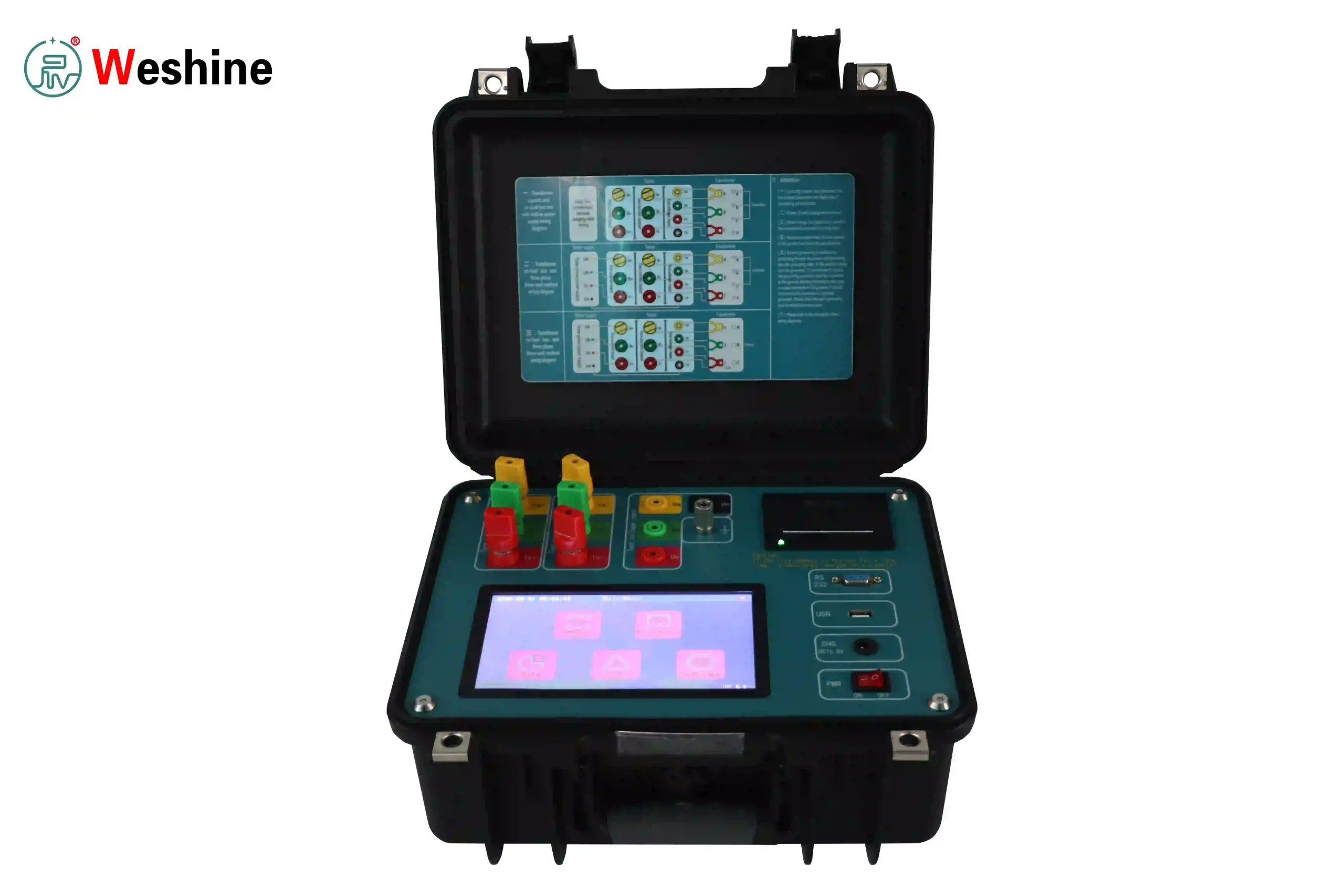


Transformer Capacity and Characteristic Tester | VS-6680
Products Details
The Transformer Capacity and Characteristic Tester is an integrated, portable diagnostic system engineered for precision field verification of transformer capacity ratings and electrical loss parameters.
In distribution grid management, parameters such as nameplate capacity, no-load loss, load loss, and short-circuit impedance voltage are crucial for billing verification, energy efficiency audits, asset management, and maintenance decision-making. When transformer nameplates are missing, altered, or suspected of misrepresenting true capacity, a reliable diagnostic tester enables engineers to verify actual operational conditions on-site.
All-in-One Field Diagnostic Architecture
This versatile system combines multiple instrument functions into a single rugged unit. It serves as an active capacity analyzer, no-load/load loss parameter meter, harmonic analyzer, and digital oscilloscope:
-
Built-in Precision AC Source: Integrates an internal three-phase, precision 50 Hz pure sine wave AC test source (0–10 V, 0–10 A). This allows engineers to perform complete capacity tests and active short-circuit load measurements without dragging heavy external power sources, voltage regulators, or current boosters into the field.
-
Full Characteristic Analysis: When paired with external power sources or induction regulators, the tester handles large-capacity transformer diagnostics. It measures no-load current, no-load loss, load loss, impedance voltage, voltage (up to AC 1000 V), current (up to AC 100 A), power factor, and active/reactive/apparent power.
-
Smart Correction Algorithms: Built-in algorithms automatically apply waveform distortion correction, temperature correction (standardized to 75°C or 115°C), non-rated voltage correction, and non-rated current correction to ensure high measurement precision under varying field environments.
-
Advanced Processing Platform: Powered by an ARM + FPGA + ADC hardware architecture running on the RT-Thread real-time operating system, featuring a 7-inch high-brightness color touchscreen with icon-driven menus and built-in wiring guidance.
Technical Specifications
| System Specifications | |
| Item | Specification |
| Product model | VS-6680 |
| Product type | Transformer capacity and characteristic tester |
| Processor architecture | ARM + FPGA + ADC |
| Operating system | RT-Thread real-time operating system |
| Display | 7-inch color high-brightness LCD touch screen |
| Operation interface | Icon-based touch interface |
| Data storage | 1000 groups of test data |
| Communication | USB, RS232, Bluetooth, WiFi |
| Remote upgrade | Supported |
| Built-in battery | Rechargeable battery |
| Battery endurance | More than 200 transformer measurements after full charge |
| Internal test source | Three-phase precision 50 Hz sine wave AC source |
| Internal Power Output | |
| Item | Specification |
| Output voltage range | 0 to 10 V |
| Output current range | 0 to 10 A |
| Output frequency | 50 Hz sine wave |
| Characteristic Channel Measurement | ||
| Item | Range | Accuracy |
| AC voltage | 1000 V | ±0.2% F.S ±1 digit |
| AC current | 100 A | ±0.2% F.S ±1 digit |
| Power And Loss Measurement | |
| Item | Specification |
| Power accuracy, 0.1 ≤ CosΦ ≤ 1 | ±0.5% F.S |
| Power accuracy, 0.02 ≤ CosΦ ≤ 0.1 | ±1.0% F.S |
| No-load / load loss measurement accuracy, 0.1 ≤ CosΦ ≤ 1 | ±2% |
| Transformer Capacity Test | |
| Item | Specification |
| Capacity test range | 6.3 to 125000 kVA |
| Supported transformer voltage input | Up to 500 kV for rated voltage parameter setting |
| Capacity result functions | Measured capacity, judged capacity, loss comparison, impedance voltage reference |
| Power Supply And Insulation | |
| Item | Specification |
| Charger input | AC 160 V to 265 V |
| Insulation resistance | Capacity test, voltage input, and current input terminals to enclosure: ≥100 MΩ |
| Withstand voltage | Charger input to enclosure: 2 kV RMS power frequency for 1 minute |
| Environmental And Physical Data | |
| Item | Specification |
| Operating temperature | -20°C to +60°C |
| Main unit dimensions | 32 × 24 × 13 cm |
| Main unit weight | 4 kg |
| Applicable Standards | |
| Standard | Description |
| GB 1094.1-2013 | Power Transformers - Part 1: General |
| GB 1094.5-2008 | Power Transformers - Part 5: Ability to Withstand Short Circuit |
| GB/T 6451-2015 | Technical Parameters and Requirements for Three-Phase Oil-Immersed Power Transformers |
| JB/T 10318-2002 | Technical Parameters and Requirements for Oil-Immersed Amorphous Alloy Core Distribution Transformers |
| GB/T 10228-2015 | Technical Parameters and Requirements for Dry-Type Power Transformers |
| GB/T 22072-2008 | Technical Parameters and Requirements for Dry-Type Amorphous Alloy Core Distribution Transformers |
| JB/T 3837-2016 | Model Designation Method for Transformer Products |
| Main Interfaces And Terminals | |
| Item | Description |
| Current input terminals | Ia+, Ib+, Ic+ |
| Current output terminals | Ia-, Ib-, Ic- |
| Voltage input terminals | Ua, Ub, Uc, Un |
| Grounding terminal | Protective grounding |
| Printer | Built-in panel printer |
| Communication ports | RS232 and USB |
| Wireless communication | Bluetooth and WiFi |
| Charging port | Battery charging |
| Power switch | Main instrument power |
Compliance Standards
-
GB 1094.1-2013 / IEC 60076-1: Power Transformers – Part 1: General
-
GB 1094.5-2008 / IEC 60076-5: Power Transformers – Part 5: Ability to Withstand Short Circuit
-
GB/T 6451-2015: Technical Parameters and Requirements for Three-Phase Oil-Immersed Power Transformers
-
GB/T 10228-2015: Technical Parameters and Requirements for Dry-Type Power Transformers
Operating Guide & Testing Workflow
Capacity Test Setup
-
Parameter Entry: Input primary/secondary rated voltages, transformer type, nominal tap position, tested temperature, and nameplate capacity.
-
Standard Tap Alignment: Ensure the transformer tap position matches the parameter selection (typically standard Tap 2 or Tap 3 for 5-position distribution transformers).
-
Safety Grounding: Connect the protective ground terminal before making high-current low-voltage lead connections.
-
Automated Analysis: Execute the capacity test using the internal three-phase source. The screen directly outputs measured capacity, judged capacity class, corrected 75°C load loss, and short-circuit impedance percentage.
Characteristic Loss Testing
For comprehensive no-load loss and load loss diagnostics, field technicians can utilize our dedicated Transformer Load No Load Loss Tester workflows. The system displays real-time voltage/current waveforms, power factor angles, and harmonic content to confirm proper circuit connection before logging data.
Key Features
-
High-precision Transformer Capacity and Characteristic Tester covering ratings from 6.3 kVA to 125 MVA.
-
Integrated internal three-phase precision 50 Hz AC source enables active capacity verification without external power gear.
-
Built-in rechargeable lithium battery supports over 200 transformer field tests on a single charge.
-
Measures no-load loss, load loss, no-load current percentage, short-circuit impedance voltage, and full electrical parameters.
-
Wide input channels: direct measurement up to AC 1000 V and AC 100 A.
-
Automated multi-parameter correction: temperature, waveform distortion, non-rated voltage, and non-rated current.
-
Real-time graphical display of voltage and current waveforms alongside harmonic analysis.
-
7-inch high-brightness touch display with on-screen electronic wiring diagrams and step-by-step help manuals.
-
Internal database stores up to 1000 complete test records with USB export, Bluetooth, WiFi, and RS232 connectivity.
-
Automatically infers national/international energy efficiency performance levels for distribution transformers.
Application Scenarios
-
Power Utilities & Distribution Networks: On-site inspection to detect unrecorded transformer capacity replacements, verify nameplate authenticity, and control grid losses.
-
Transformer Manufacturing & FAT: Factory quality assurance, capacity compliance verification, and baseline loss parameter testing for oil-immersed and dry-type units.
-
Industrial Facilities & Mining Enterprises: Energy efficiency auditing, capacity checks for aging assets, and maintenance evaluation during planned turnarounds.
-
Railway Electrification Systems: Verification of traction power supply transformers and distribution assets subjected to fluctuating loads.
-
Third-Party Testing Laboratories: Comprehensive transformer asset verification, compliance reporting, and forensic diagnostic testing.
Applications
-
Distribution transformer capacity blind testing and nameplate verification.
-
Transformer no-load loss and no-load current measurement.
-
Transformer load loss and short-circuit impedance voltage measurement.
-
Transformer energy efficiency level reference determination.
-
Harmonic content and power quality analysis during transformer load tests.
-
On-site archive management and PC data report generation.
Customer Case Study
-
Industry: Power Utility Distribution Inspection
-
Challenge: A power grid utility launched an audit to inspect distribution transformers across a rural network where several nameplates were unreadable or suspected of under-reporting installed capacity. Conventional test setups required heavy three-phase generators, voltage regulators, and extensive field cabling.
-
Testing Process: The inspection team deployed this portable tester utilizing its internal battery and built-in three-phase 50 Hz source. Technicians connected customized shorting leads, entered oil temperature and nominal voltage parameters, and performed automated capacity diagnostics within minutes per site.
-
Result & Benefit: The utility accurately verified actual installed transformer capacity, identified several non-compliant units, and generated traceable diagnostic reports on-site. The lightweight setup reduced field testing time by over 60%.
Frequently Asked Questions (FAQ)
Q1: Does this Transformer Capacity and Characteristic Tester require an external power supply for capacity testing?
No. For distribution transformer capacity and active load tests within the internal output limit, the instrument utilizes its built-in three-phase 50 Hz precision AC test source. External power regulators are only required for high-capacity characteristic testing.
Q2: What is the capacity measurement range of the tester?
The instrument tests transformer capacities ranging from 6.3 kVA up to 125,000 kVA (125 MVA), covering standard distribution units up to large power transformers.
Q3: How does the system correct test data for field temperature variations?
The tester prompts the operator to input current winding or oil temperature and automatically applies mathematical correction formulas to convert measured load losses and impedance voltages to the standard reference temperature (e.g., 75°C).
Q4: How many test records can be saved, and how are they exported?
The internal database stores up to 1000 complete test groups. Records can be exported via USB flash drive, uploaded to a PC, or transferred wirelessly via Bluetooth or WiFi.
Weshine Advantages
Weshine Electric is a specialized manufacturer of advanced high-voltage diagnostic equipment and complete transformer test equipment solutions. For distribution grid management and transformer manufacturing quality control, Weshine delivers field-proven diagnostic tools with user-friendly touchscreen interfaces, precise digital sampling, and robust safety protection.
Supported by deep technical expertise, ISO-certified manufacturing, and global technical service, Weshine empowers utilities and electrical contractors worldwide to improve field testing efficiency and ensure long-term grid power stability.