






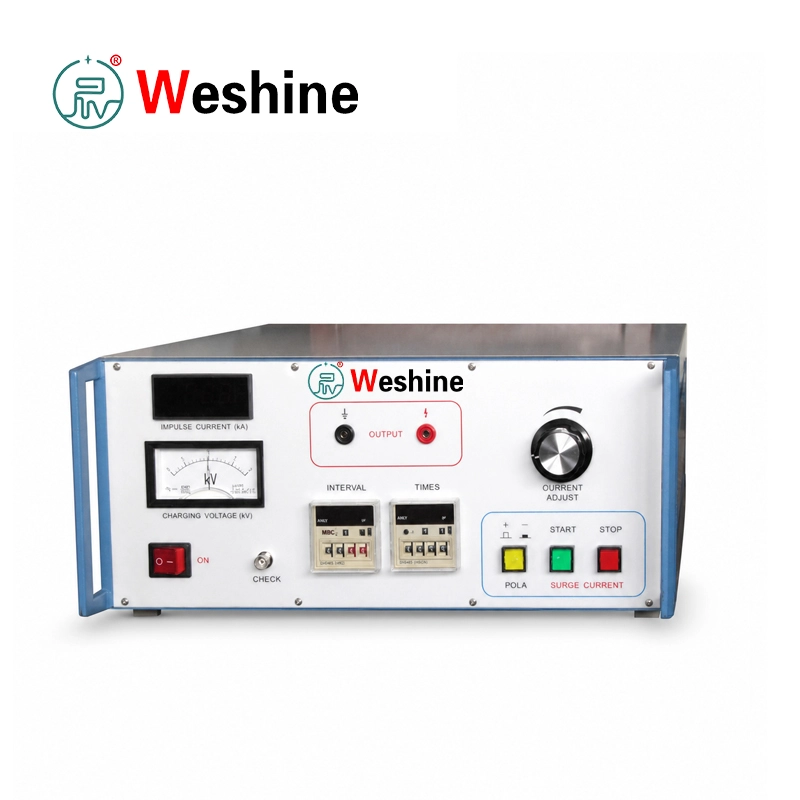

Impulse Current Test System | VS-CJ
Products Details
The VS-CJ is used for type testing, product development, and quality verification of low-voltage electrical equipment that must withstand transient impulse current without unwanted tripping or functional failure. In practical power systems, switching operations, lightning-related surges, and transient disturbances can create short-duration impulse currents. Protective devices must respond correctly: they should trip when required, but they should also avoid nuisance operation under specified test conditions.
For residual current operated protective devices and low-voltage circuit breakers, impulse current testing is an important part of product validation. The VS-CJ provides controlled current impulses with defined waveform parameters, allowing engineers to evaluate whether the tested device meets its design requirement under standard transient conditions.
The ring wave impulse current configuration provides a 0.5 µs wave front with a 100 kHz oscillation characteristic. It is suitable for 25 A and 200 A test current applications, with adjacent peak attenuation controlled within the stated range. This configuration is used for anti-misoperation tests under ring wave impulse current conditions.
The 8/20 µs pulse current configuration is suitable for surge current testing of leakage protection devices and related low-voltage protection products. The waveform has an 8 µs front time and 20 µs time to half current value, with no reverse current peak. The output current is continuously adjustable within the stated range, allowing the user to match the test requirement to the device under test.
The system is equipped with waveform detection output. Users can connect an external digital storage oscilloscope to monitor the output waveform during test setup, verification, and periodic checking. This is useful for laboratories that need visible waveform evidence during type testing or internal quality control.
Specification
| Technical Parameters | |
| Item | Specification |
| Product Model | VS-CJ |
| Product Type | Impulse current test system |
| Main Test Objects | Low-voltage circuit breakers, residual current devices, leakage protection devices, and related protection equipment |
| Main Test Purpose | Anti-misoperation and impulse current immunity verification |
| Available Waveform 1 | 0.5 µs / 100 kHz ring wave impulse current |
| Ring Wave Front Time | 0.5 µs ±30% |
| Ring Wave Oscillation Period | 10 µs ±20% |
| Adjacent Peak Attenuation | 50%-70% |
| Ring Wave Current Configuration | 25 A test current / 200 A test current |
| Peak Current Output for 25 A Configuration | 23-28 A |
| Peak Current Output for 200 A Configuration | 170-230 A |
| Ring Wave Peak Measurement Accuracy | ≤ +10% |
| Available Waveform 2 | 8/20 µs pulse current / surge current |
| 8/20 µs Wave Front Time | 8 µs ±20% |
| Time to Half Current Value | 20 µs ±20% |
| Reverse Current Peak | No reverse current |
| 8/20 µs Peak Current Output | 230-280 A, continuously adjustable |
| 8/20 µs Peak Measurement Accuracy | ≤ ±5% |
| Polarity | Positive, negative |
| Impulse Interval | 30-99 seconds |
| Impulse Count | 1-9999 times |
| Waveform Monitoring | Waveform detection output for external digital storage oscilloscope |
| Applicable Standards Mentioned in Technical Scheme | GB 16916.1, GB 16917.1, GB 14048.2, IEC 61009-1, IEEE C62.41; 8/20 µs configuration references GB 14048.2-2001 B 8.6.2 |
Product Guide
- Confirm the test standard, required waveform, target impulse current, and polarity before testing.
- Select the corresponding VS-CJ configuration: ring wave impulse current for 25 A or 200 A tests, or 8/20 µs pulse current for adjustable 230-280 A surge current testing.
- Place the device under test in the correct test circuit and check that all wiring is secure.
- Set the impulse interval according to the test procedure, typically within the 30-99 second range.
- Set the required impulse count from 1 to 9999 times.
- Select positive or negative polarity according to the test requirement.
- For waveform confirmation, connect the waveform detection output to a digital storage oscilloscope.
- Start the test and observe whether the device under test trips, remains closed, or shows abnormal response.
- Record peak current, waveform condition, test count, polarity, and test result.
- After testing, discharge and isolate the test circuit before removing the sample.
Features
- Supports impulse current testing for low-voltage electrical products.
- Provides 0.5 µs / 100 kHz ring wave impulse current output.
- Provides 8/20 µs surge current output according to configuration.
- Measures device behavior under transient current and anti-misoperation test conditions.
- Detects whether protective devices trip incorrectly under specified impulse current.
- Supports positive and negative polarity output.
- Provides adjustable impulse interval from 30 to 99 seconds.
- Provides impulse count setting from 1 to 9999 times.
- Displays peak current through digital indication according to configuration.
- Includes waveform detection output for external oscilloscope monitoring.
- Automatically supports repeated impulse output according to preset test count.
- Provides continuously adjustable peak current output in the 8/20 µs configuration.
Application Scenarios
The VS-CJ is suitable for laboratories performing type tests on residual current devices, low-voltage circuit breakers, and leakage protection products. It helps verify whether the product can withstand specified transient impulse current without unwanted tripping.
For manufacturers, the system can be used during product development to compare different trip mechanisms, circuit structures, and protection designs. Engineers can evaluate how design changes affect impulse current immunity before submitting products for certification or customer approval.
In quality inspection departments, the VS-CJ can be used for batch sampling tests. By setting a fixed waveform, polarity, impulse interval, and current level, inspectors can evaluate whether production units maintain consistent anti-misoperation performance.
For third-party testing organizations, the waveform detection output allows the test process to be monitored with an external oscilloscope, supporting waveform confirmation and technical reporting.
Applications
- Residual current device impulse current testing
- Leakage protection device anti-misoperation testing
- Low-voltage circuit breaker transient current testing
- 25 A ring wave impulse current test
- 200 A ring wave impulse current test
- 8/20 µs surge current test
- Type testing for low-voltage electrical products
- Product development and design verification
- Quality control sampling test
- Laboratory waveform verification with oscilloscope monitoring
Customer Case
A low-voltage protection device manufacturer needed to verify whether a new leakage protection product could remain stable during specified transient current disturbances. The engineering team used the VS-CJ system to apply ring wave impulse current tests at the required current level and polarity.
During the test process, the operator set the impulse interval and impulse count according to the internal test procedure. The waveform detection port was connected to a digital storage oscilloscope so that the test waveform could be checked during setup and recorded for the engineering report.
The test helped the manufacturer identify samples that showed unwanted tripping under impulse current conditions. After adjustment of the protection mechanism and circuit design, the product showed more consistent behavior during repeated impulse tests, supporting further type-test preparation.
FAQ
- What is the VS-CJ used for?
The VS-CJ is used to test the impulse current immunity and anti-misoperation performance of low-voltage protection devices, such as residual current devices, leakage protection devices, and circuit breakers. - What impulse current waveforms are supported?
The technical scheme includes 0.5 µs / 100 kHz ring wave impulse current and 8/20 µs pulse current configurations. - What current levels are available?
The ring wave configuration supports 25 A and 200 A test current applications. The 8/20 µs configuration provides continuously adjustable 230-280 A peak current output. - Can the system test both positive and negative polarity?
Yes. The system supports positive and negative polarity output. - Can the waveform be monitored?
Yes. The instrument includes a waveform detection output, which can be connected to an external digital storage oscilloscope. - What is the impulse count range?
The impulse count can be set from 1 to 9999 times. - What is the impulse interval range?
The impulse interval can be set from 30 to 99 seconds. - Which standards are referenced in the technical scheme?
The supplied scheme references GB 16916.1, GB 16917.1, GB 14048.2, IEC 61009-1, IEEE C62.41, and GB 14048.2-2001 B 8.6.2 for the 8/20 µs configuration.
Weshine Advantages
Weshine provides electrical test equipment for power systems, low-voltage electrical products, insulation testing, transformer testing, cable testing, and laboratory verification. For impulse current testing, Weshine can help users select the suitable VS-CJ configuration according to waveform requirement, test current level, tested product type, and reporting needs.
Weshine supports customers with product selection, test setup guidance, operation training, and practical configuration advice. For users who need waveform monitoring, repeated impulse testing, or integration into a laboratory workflow, Weshine can provide a matching solution based on the stated technical parameters and application requirements.