






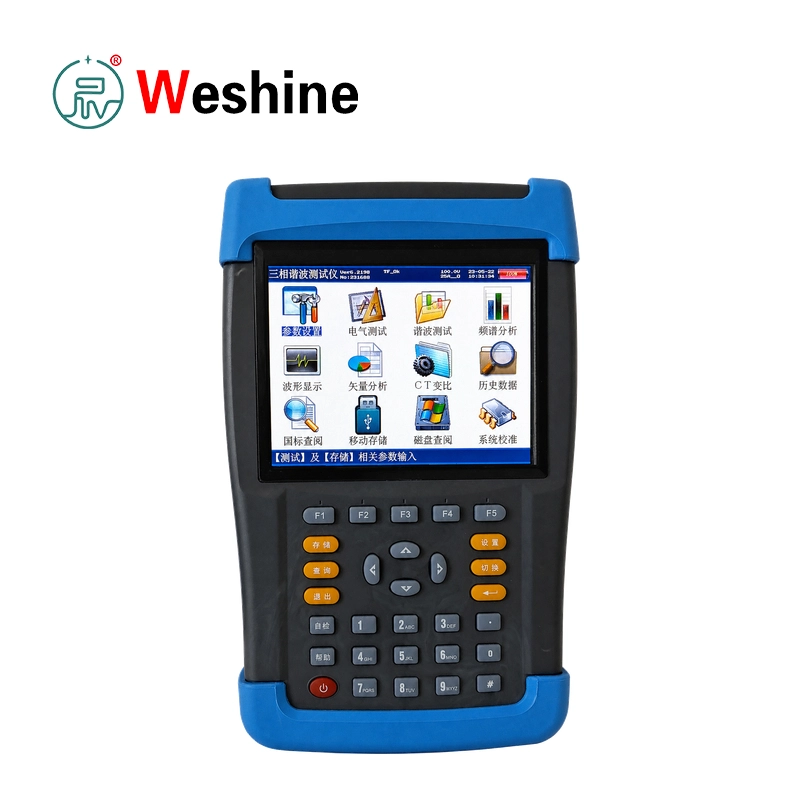


Handheld Power Quality Analyzer | VS-X710
Products Details
Modern power systems are increasingly affected by nonlinear, impact, and unbalanced loads. Equipment such as rectifiers, variable-frequency drives, electric arc furnaces, electric railway systems, UPS systems, and other power electronic devices can introduce harmonic current, voltage fluctuation, flicker, poor power factor, and three-phase unbalance. These problems may reduce power transmission efficiency, overheat transformers and cables, damage capacitors, accelerate insulation aging, and interfere with sensitive electrical equipment.
The VS-X710 Handheld Power Quality Analyzer is developed for field measurement and analysis of these power quality conditions. It can measure common electrical parameters including voltage, current, active power, reactive power, apparent power, phase angle, frequency, power factor, active energy, and reactive energy. At the same time, it provides dedicated power quality functions such as harmonic analysis, waveform display, spectrum analysis, voltage deviation, voltage fluctuation, short-term flicker, long-term flicker, and three-phase unbalance measurement.
For maintenance and troubleshooting, the VS-X710 helps engineers see both numerical data and visual evidence. The waveform display function shows real-time voltage and current waveforms, making it easier to identify waveform distortion, clipping, phase shift, or abnormal load behavior. The vector analysis function displays the voltage and current vector relationship, which is useful for checking metering wiring, CT/PT polarity, phase sequence, and the inductive or capacitive nature of the load.
The instrument uses clamp-type current transformers, allowing current measurement without opening the current circuit. This is important for field safety and convenience, especially in operating distribution panels. Different current clamp ranges can be selected according to the site requirement, including standard 5 A/25 A clamps and optional higher-current clamp or flexible coil ranges.
The VS-X710 is also suitable for long-term monitoring. Users can set different storage intervals and continuously record voltage, current, active power, reactive power, apparent power, frequency, phase, and other electrical parameters. When the storage interval is set to 1 minute, the instrument can continuously store data for more than 18 months, making it practical for tracking load fluctuation, harmonic variation, compensation device performance, and recurring power quality events.
The instrument is equipped with a large color LCD, Chinese operating interface, screen lock function, USB interface, serial communication, and optional WiFi or Bluetooth remote control module. With data management software, stored data and real-time sampling data can be transferred to a computer for report generation, trend review, and deeper analysis. Its handheld size, rechargeable lithium battery, and portable structure make it suitable for both on-site power quality audits and laboratory reference measurements.
Specification
| Technical Parameters | |
| Item | Specification |
| Product model | VS-X710 |
| Product type | Handheld Power Quality Analyzer |
| Voltage measurement range | 10 V to 800 V, automatic range switching |
| Current measurement range | 5 A / 25 A clamp CT, standard |
| Optional current range | 100 A / 500 A clamp CT |
| Optional current range | 400 A / 2000 A clamp CT |
| Optional current range | 1000 A / 5000 A flexible coil |
| Phase angle measurement range | 0° to 359.99° |
| Frequency measurement range | 45 Hz to 65 Hz |
| Voltage channels | 3 channels: UA, UB, UC |
| Current channels | 3 channels: IA, IB, IC |
| Maximum harmonic analysis order | 63rd order |
| Maximum continuous storage period | More than 18 months at 1-minute interval |
| Voltage accuracy | ±0.1% |
| Frequency accuracy | ±0.01 Hz |
| Current accuracy | ±0.5% |
| Power accuracy | ±0.5% |
| Phase accuracy | ±0.2° |
| Fundamental voltage error | ≤0.5% F.S. |
| Fundamental current error | ≤1% F.S. |
| Fundamental voltage-current phase error | ≤0.2° |
| Harmonic voltage content error | ≤0.1% |
| Harmonic current content error | ≤0.2% |
| Three-phase voltage unbalance error | ≤0.2% |
| Voltage deviation error | ≤0.2% |
| Voltage fluctuation error | ≤0.2% |
| Operating temperature | -10°C to +40°C |
| Charging power supply | AC 220 V, 45 Hz to 65 Hz |
| Main unit power consumption | ≤3 VA |
| Battery operating time | ≤10 hours |
| Insulation resistance | Voltage/current input terminals to enclosure: ≥100 MΩ |
| Withstand voltage | Power input to enclosure: 1.5 kV RMS, 1 minute |
| Interface | USB, serial port |
| Optional communication | WiFi / Bluetooth module |
| Display | Large color LCD |
| Battery | Built-in rechargeable lithium-ion battery |
| Dimensions | 258 mm × 158 mm × 58 mm |
| Weight | 1.5 kg |
Product Guide
Before measurement, the operator should confirm the wiring system and select the correct test mode. The VS-X710 supports common field wiring methods, including three-phase four-wire and three-phase three-wire systems. Correct selection of wiring mode, PT ratio, CT ratio, current input range, rated voltage, station name, line name, storage interval, and file name is important for accurate measurement and later data management.
For voltage measurement, connect the voltage test leads to the instrument first, then connect them to the tested equipment. In a three-phase four-wire system, the yellow, green, red, and black leads are connected to phase A, phase B, phase C, and neutral respectively. In a three-phase three-wire system, three voltage leads are used according to the site wiring arrangement. When removing the voltage leads, disconnect the tested equipment side first and then remove the instrument side connection.
For current measurement, connect each clamp current transformer to its corresponding input socket before clamping the tested conductor. The clamps should not be interchanged between channels, because each clamp is matched to its measurement input and incorrect connection can reduce accuracy. The polarity mark should also be observed during connection, because reversed polarity can affect phase angle, power, and vector analysis results.
After wiring, the operator can enter the electrical test interface to view voltage, current, power, phase, frequency, power factor, sequence components, unbalance, flicker, and energy data. If the user needs to observe distortion, the waveform display interface can show real-time voltage and current waveforms. For harmonic investigation, the harmonic test and spectrum analysis interfaces provide harmonic content, THD, RMS value, and harmonic distribution information.
For long-term monitoring, set the storage interval before starting the test. The instrument can record electrical parameters at intervals from seconds to minutes and save them in the internal storage. Data can later be copied through USB or uploaded to a computer through the communication interface and data management software. During long-duration monitoring, external charging power should be connected to avoid battery depletion.
The instrument includes a screen lock function to make field reading easier. It also includes a power-saving display mode when there is no operation for several minutes. After each test, users should save important data, remove test leads in the correct order, close the work power supply, and recharge the battery as needed.
Features
- Supports three-phase voltage, current, power, frequency, phase angle, and power factor measurement.
- Measures active power, reactive power, apparent power, active energy, and reactive energy.
- Provides power quality analysis for frequency deviation, voltage deviation, voltage fluctuation, flicker, harmonics, and three-phase unbalance.
- Supports voltage harmonic and current harmonic analysis up to the 63rd order.
- Displays voltage and current waveforms for distortion and phase relationship observation.
- Provides spectrum analysis with harmonic distribution display.
- Displays vector diagrams for wiring check and phase relationship analysis.
- Measures short-term flicker Pst and long-term flicker Plt.
- Supports load fluctuation monitoring under different equipment operating states.
- Automatically records electrical parameter trends according to the selected storage interval.
- Stores long-term monitoring data for more than 18 months at a 1-minute interval.
- Includes USB interface for convenient data transfer to a computer.
- Supports real-time data upload with data management software.
- Provides optional WiFi or Bluetooth module for remote operation by tablet or smartphone.
- Includes calendar and clock functions for time-stamped test records.
- Displays multiple parameters on a large color LCD.
- Automatically enters power-saving display mode after no operation.
- Includes rechargeable lithium-ion battery for portable field use.
- Supports three-phase four-wire and three-phase three-wire measurement applications.
Application Scenarios
The VS-X710 is suitable for power quality surveys in factories, commercial buildings, substations, distribution rooms, renewable energy connection points, railway power systems, and large load centers. It helps engineers evaluate whether power supply conditions meet operational requirements and whether electrical loads are introducing distortion or imbalance into the network.
In industrial facilities, the analyzer can be used to investigate harmonic pollution from variable-frequency drives, rectifiers, welding machines, electric furnaces, UPS systems, and motor control equipment. By combining harmonic data, waveform display, spectrum analysis, and power factor measurement, engineers can determine whether compensation or filtering equipment is needed.
In utility and distribution maintenance, the VS-X710 supports field inspection of voltage deviation, frequency deviation, flicker, load fluctuation, and three-phase unbalance. Long-term trend recording helps identify problems that appear only during specific production periods, peak load periods, or equipment startup conditions.
For metering and wiring inspection, the vector analysis function helps users identify incorrect wiring, reversed current clamp polarity, phase sequence problems, CT/PT connection errors, and abnormal phase relationships. This is useful during meter installation, energy audit work, and line loss analysis.
For compensation and filtering equipment evaluation, the instrument can monitor changes before and after equipment switching. Users can compare reactive power, power factor, harmonic content, voltage fluctuation, and current waveform to judge whether the compensation or filtering device is operating as expected.
Applications
The VS-X710 Handheld Power Quality Analyzer is used by power utilities, electrical contractors, industrial maintenance departments, energy audit companies, switchgear service teams, laboratories, railway power departments, and renewable energy project teams. It is suitable for both temporary field measurement and long-term monitoring of user-side power quality.
Typical test objects include low-voltage distribution cabinets, medium-voltage secondary circuits through PT/CT input, transformers, capacitor banks, harmonic filters, motor control centers, inverter systems, production lines, commercial building feeders, and metering circuits. The instrument helps users collect real electrical data for fault diagnosis, system evaluation, energy management, and compliance review.
For B2B procurement, the VS-X710 can be described with search terms such as handheld power quality analyzer, portable power quality meter, three-phase power quality tester, harmonic analyzer, power quality monitoring instrument, and electrical network analyzer.
Customer Case
A manufacturing plant operating several variable-frequency drive production lines reported periodic overheating of compensation capacitors and unstable power factor readings. The maintenance team suspected harmonic current and load fluctuation, but the problem did not appear continuously, making it difficult to diagnose with a simple multimeter or short-duration inspection.
The team used the VS-X710 Handheld Power Quality Analyzer at the main low-voltage distribution cabinet. Voltage leads were connected to the three-phase bus, and clamp current transformers were installed on the phase conductors without opening the current circuit. The analyzer recorded voltage, current, active power, reactive power, apparent power, frequency, phase angle, harmonic content, THD, and power factor over the operating cycle of the production line.
During peak production, the stored data showed increased current harmonics and a change in reactive power demand when several drives accelerated at the same time. The waveform display confirmed visible current distortion, while the spectrum analysis identified the main harmonic orders contributing to the problem. The maintenance team used this information to adjust operating schedules and evaluate a suitable harmonic filtering solution.
After the corrective work, the VS-X710 was used again to compare the before-and-after harmonic content, power factor, and load trend. The customer kept the exported data and reports as part of the facility’s power quality record, helping both the maintenance department and management understand the cause of the issue and the effect of the improvement measures.
FAQ
- What does the VS-X710 measure?
The VS-X710 measures voltage, current, active power, reactive power, apparent power, phase angle, power factor, frequency, active energy, reactive energy, harmonics, waveform distortion, voltage deviation, voltage fluctuation, flicker, and three-phase unbalance. - How many voltage and current channels does it support?
The instrument supports three voltage channels and three current channels, identified as UA, UB, UC and IA, IB, IC. This allows three-phase power quality measurement in common field applications. - What harmonic range can the analyzer measure?
The VS-X710 can analyze harmonics up to the 63rd order. It can display harmonic content, THD, RMS values, and harmonic distribution for voltage and current signals. - Can it be used without disconnecting the current circuit?
Yes. Current is measured through clamp-type current transformers, so the operator does not need to open the current circuit during normal clamp measurement. The correct clamp range and polarity must still be selected for accurate results. - Does the instrument support long-term monitoring?
Yes. The VS-X710 can store data at configurable intervals. At a 1-minute storage interval, it can continuously store data for more than 18 months, which is useful for load trend monitoring and recurring power quality problem analysis. - What current clamp ranges are available?
The standard clamp range is 5 A / 25 A. Optional ranges include 100 A / 500 A, 400 A / 2000 A, and 1000 A / 5000 A flexible coil, allowing the instrument to adapt to different field current levels. - Can the test data be exported?
Yes. The instrument includes a USB interface and can work with data management software for uploading, processing, and reporting test data on a computer. - Does it support remote operation?
The manual specifies an optional WiFi or Bluetooth module, which allows remote operation through a tablet or smartphone when configured. - What is the battery operating time?
The built-in rechargeable lithium-ion battery supports up to 10 hours of operation according to the manual. For long-term monitoring, external charging power should be connected. - Where is the VS-X710 typically used?
It is typically used in substations, factories, commercial buildings, distribution rooms, electrical testing laboratories, railway power systems, and energy audit projects where three-phase power quality needs to be measured and analyzed.
Weshine Advantages
Weshine Electric provides electrical testing instruments for utilities, substations, industrial users, contractors, laboratories, and power equipment service companies. For the VS-X710 Handheld Power Quality Analyzer, Weshine supports customers with model selection, technical parameter confirmation, operation guidance, application consultation, and after-sales service.
Weshine understands that power quality testing requires both accurate field measurement and practical reporting. The VS-X710 helps users collect measurable data from real electrical systems, review long-term trends, analyze harmonic problems, and make maintenance decisions based on recorded evidence rather than assumptions.
For overseas distributors and project buyers, Weshine can provide product information, application support, and documentation for procurement, training, and resale. The VS-X710 is suitable for customers looking for a portable three-phase power quality analyzer for harmonic analysis, electrical parameter testing, waveform observation, and long-term power quality monitoring.