






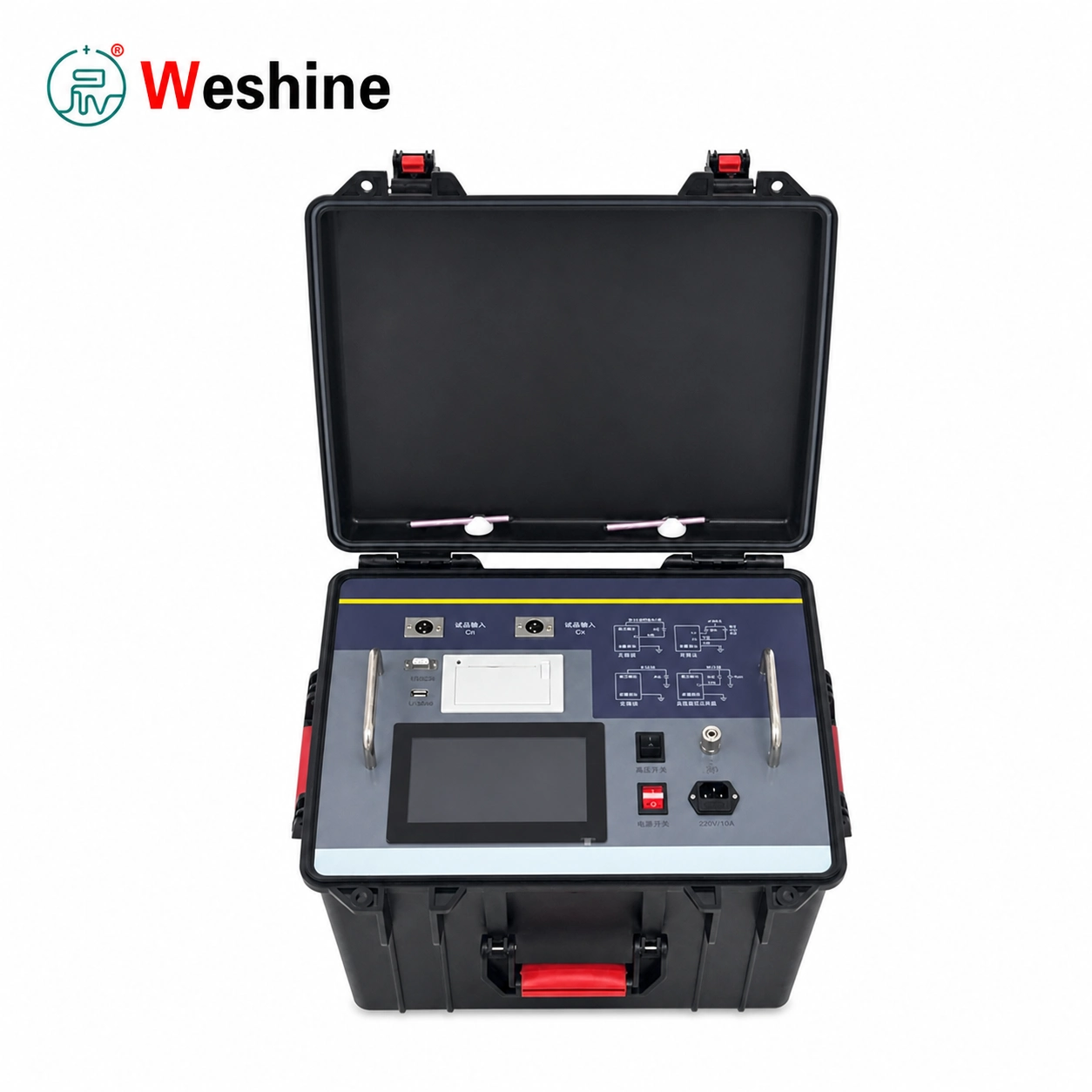


Color Screen Dielectric Loss Tester | VS-GYTD
Products Details
Dielectric loss measurement is one of the basic methods used in insulation testing. It helps detect overall insulation moisture, aging, deterioration, contamination, and partial defects in high-voltage electrical equipment. For transformers, instrument transformers, reactors, capacitors, bushings, and surge arresters, capacitance and tan delta measurement are important indicators for judging insulation condition during factory testing, commissioning, and routine preventive testing.
The VS-GYTD Color Screen Dielectric Loss Tester is designed to replace traditional bridge-type measurement with a more automated digital test method. The instrument uses variable frequency power supply technology, single-chip microcomputer control, modern electronic measurement circuits, automatic frequency conversion, digital filtering, and data calculation. This makes it suitable for field testing where 50 Hz power-frequency interference may affect conventional measurement.
The built-in high-voltage power supply can output pure sine wave test voltage and automatically apply voltage up to 10 kV. By using 45 Hz / 55 Hz dual-frequency testing or other selectable frequencies within the specified range, the tester can automatically filter 50 Hz interference. The manual states that the instrument can still maintain the specified accuracy under 200% interference, which is useful for substations and other strong electromagnetic environments.
The VS-GYTD supports multiple test modes, including forward connection, reverse connection, reverse connection with low-voltage shielding, and AC withstand voltage test. The reverse connection low-voltage shielding function is especially useful for certain CVT field tests, allowing C11 dielectric loss measurement under specific grounding conditions without disassembly.
The instrument integrates a standard capacitor and high-voltage source in one unit, reducing external wiring during common field tests. It can also recognize external high-voltage source frequency from 40 Hz to 70 Hz, allowing use with power-frequency sources or series resonance sources for large-capacity or high-voltage dielectric loss testing.
Data management is built into the instrument. Test results can be stored internally with time information, printed by the built-in thermal printer, exported through a U disk, or transferred through the RS232 computer interface. One computer can control up to 32 instruments according to the manual, making the tester suitable for integration into comprehensive high-voltage test vehicles or centralized test systems.
Specification
| Technical Parameters | |
| Item | Specification |
| Product model | VS-GYTD |
| Product type | Color Screen Dielectric Loss Tester / Tan Delta Tester |
| Measurement parameters | Capacitance Cx, dielectric loss factor tgδ, related insulation parameters |
| Cx accuracy | ±(reading × 1% + 1 pF) |
| tg未 accuracy | ±(reading × 1% + 0.00040) |
| Anti-interference performance | Variable frequency anti-interference; stated accuracy maintained under 200% interference |
| Internal HV capacitance range | 3 pF to 60000 pF / 10 kV; 60 pF to 1.5 uF / 0.5 kV |
| External HV capacitance range | 3 pF to 1.5 uF / 10 kV; 60 pF to 30 uF / 0.5 kV |
| Capacitance resolution | Up to 0.001 pF, 4 significant digits |
| tg未 range | Unlimited |
| tg未 resolution | 0.00% |
| Test current range | 5 uA to 5 A |
| Internal high-voltage setting range | 0.5 kV to 10 kV |
| Internal high-voltage maximum output current | 200 mA |
| Voltage setting | Freely adjustable voltage setting |
| Test frequency | 40 Hz to 70 Hz single frequency, freely selectable |
| Dual-frequency mode | 50 ±0.1 Hz to 50 ±10 Hz; 60 ±0.1 Hz to 60 ±10 Hz |
| Frequency accuracy | ±0.01 Hz |
| External high voltage, forward connection | Max. test current 5 A, power frequency or variable frequency 40-70 Hz |
| External high voltage, reverse connection | Max. 10 kV / 5 A, power frequency or variable frequency 40-70 Hz |
| Measurement time | About 40 s, depending on test mode |
| Input power supply | 180 V to 270 V AC, 50 Hz ±1%, mains or generator |
| Computer interface | Standard RS232 |
| Data export | U disk port, automatic U disk data storage |
| Printer | Micro thermal printer |
| Operating temperature | -10°C to +50°C |
| Relative humidity | <90% |
| Dimensions | 500 mm × 377 mm × 330 mm |
| Instrument weight | 28 kg |
Product Guide
Before measurement, the operator should confirm the test object, test mode, voltage level, wiring method, grounding condition, and safety clearance. The instrument generates high voltage during operation, so the test area should be clearly isolated. Non-test personnel should stay away from high-voltage leads, terminals, and the tested equipment.
Grounding is the first required step. Connect the grounding terminal of the VS-GYTD to a reliable earth point before making any other test connection. The instrument includes grounding protection; if the grounding wire is not connected properly, the instrument will not enter normal operation and will not output high voltage.
After powering on, the tester performs a self-check and enters the main test interface. The screen displays the previous test parameters, such as test frequency, test mode, and test voltage. Operators can use the touch screen to set the test frequency, test mode, test voltage, standard capacitor selection, and withstand test duration when required.
For common field dielectric loss tests, the internal high-voltage source and internal standard capacitor are normally selected. The test mode can be chosen from forward connection, reverse connection, reverse connection low-voltage shielding, or AC withstand voltage. Forward connection is commonly used for grounded test objects, while reverse connection is used for test objects where the measurement side is not directly grounded. The low-voltage shielding mode can be used for certain CVT applications.
The test voltage can be set freely within the supported range, up to 10 kV for internal high-voltage testing. The operator may select single-frequency testing from 40 Hz to 70 Hz or dual-frequency testing such as 45 / 55 Hz or 55 / 65 Hz equivalent settings depending on the chosen frequency band. In strong interference environments, dual-frequency testing is commonly used to reduce power-frequency interference.
After confirming wiring and settings, start the measurement. The microprocessor controls voltage output, data acquisition, digital filtering, and calculation. Test results are displayed on the touch screen and may include capacitance, dielectric loss factor, test voltage, frequency, current, and related values. Results can be stored, printed, or exported through U disk for later report management.
After testing, the operator should turn off high-voltage output, wait for discharge, and ground the tested object before changing leads or touching any high-voltage connection. If the instrument reports overcurrent, poor grounding, abnormal wiring, or protection action, the test should be stopped and the wiring condition checked before repeating the measurement.
Features
- Supports dielectric loss factor and capacitance measurement for high-voltage insulation testing.
- Measures transformers, CTs, PTs, reactors, capacitors, bushings, surge arresters, and insulating oil test cells.
- Uses Fourier transform digital filtering for capacitance and dielectric loss measurement.
- Provides variable frequency anti-interference testing for strong electromagnetic field environments.
- Automatically filters 50 Hz interference during field testing.
- Provides built-in high-voltage output up to 10 kV.
- Includes internal standard capacitor and integrated high-voltage power supply.
- Supports forward connection, reverse connection, reverse connection low-voltage shielding, and AC withstand test modes.
- Detects capacitance, inductance, and resistance test objects automatically.
- Supports internal high voltage and external high voltage test applications.
- Stores test data with calendar and clock information.
- Includes built-in thermal printer for field reports.
- Provides U disk export for data management on PC software.
- Includes RS232 computer interface for remote control and data transfer.
- Provides grounding protection, overcurrent protection, and electric shock protection.
- Supports optional Bluetooth communication according to the manual.
Application Scenarios
The VS-GYTD is suitable for substation preventive testing where field electromagnetic interference is common. Its variable frequency anti-interference method helps maintenance teams obtain stable capacitance and tan delta results from transformers, bushings, CTs, PTs, capacitors, surge arresters, and other high-voltage equipment.
In electrical equipment manufacturing, the tester can be used for factory insulation quality checks. Manufacturers can use capacitance and dielectric loss measurements to verify insulation status before shipment or after assembly.
During installation and commissioning, the instrument supports acceptance testing for newly installed transformers, instrument transformers, bushings, and capacitive equipment. Built-in high voltage and internal standard capacitor reduce the need for extra external equipment in many field applications.
For CVT and bushing testing, reverse connection and reverse connection low-voltage shielding modes help users adapt to different site wiring requirements. This is useful where equipment structure or grounding conditions make standard forward connection difficult.
For oil dielectric loss testing, the manual states that the instrument can meet oil dielectric loss measurement requirements when equipped with a standard oil cup. This allows laboratories or field teams to add insulating oil dielectric loss testing to their maintenance workflow.
Applications
The VS-GYTD Color Screen Dielectric Loss Tester is used by power utilities, substations, transformer manufacturers, high-voltage laboratories, electrical commissioning companies, power equipment maintenance contractors, industrial power departments, and comprehensive high-voltage test vehicle operators.
Typical test objects include power transformers, current transformers, voltage transformers, capacitors, capacitive voltage transformers, bushings, reactors, surge arresters, insulating oil cups, and other insulation systems where dielectric loss factor and capacitance are key diagnostic parameters.
For overseas SEO and B2B procurement, the product can be described as a dielectric loss tester, tan delta tester, capacitance and dissipation factor tester, transformer tan delta test set, insulation dielectric loss analyzer, and high-voltage capacitance tester.
Customer Case
A substation maintenance team needed to perform preventive dielectric loss testing on transformers, bushings, CTs, and capacitors in a 220 kV substation. The site had strong electromagnetic interference, and previous bridge-based measurements often required repeated setup and careful interpretation.
The team used the VS-GYTD Color Screen Dielectric Loss Tester with variable frequency testing. After grounding the instrument and isolating the test area, technicians selected the appropriate test mode for each device. For standard equipment, internal high voltage and internal standard capacitor were used. For special CVT-related work, the reverse connection low-voltage shielding function helped complete measurement under site conditions.
The tester automatically applied voltage, performed frequency conversion, filtered interference, calculated capacitance and tan delta values, and displayed results on the touch screen. Data was stored internally, printed on site, and exported by U disk for maintenance records.
The customer used the measured tan delta and capacitance data to compare historical records and identify equipment requiring closer monitoring. The automatic workflow reduced manual bridge balancing work and improved test record management across the maintenance team.
FAQ
- What is the VS-GYTD used for?
It is used to measure dielectric loss factor, capacitance, and related insulation parameters of high-voltage electrical equipment such as transformers, CTs, PTs, capacitors, bushings, reactors, and surge arresters. - What is the maximum internal test voltage?
The internal high-voltage source can be set from 0.5 kV to 10 kV, with maximum output current of 200 mA. - How does the instrument reduce field interference?A3: It uses variable frequency testing and digital filtering. The manual states that it can maintain the specified accuracy under 200% interference.
- What test modes are available?A4: The instrument supports forward connection, reverse connection, reverse connection low-voltage shielding, and AC withstand voltage test modes.
- Can it use an external high-voltage source?A5: Yes. It can recognize external high-voltage source frequency from 40 Hz to 70 Hz and supports external high-voltage dielectric loss testing for large-capacity or high-voltage applications.
- What is the capacitance measurement range?A6: With internal high voltage, the range is 3 pF to 60000 pF at 10 kV and 60 pF to 1.5 uF at 0.5 kV. With external high voltage, the range is 3 pF to 1.5 uF at 10 kV and 60 pF to 30 uF at 0.5 kV.
- Can results be printed and exported?A7: Yes. The VS-GYTD includes a micro thermal printer, U disk export, internal storage, and RS232 computer interface.
- Does it include safety protection?A8: Yes. It includes grounding protection, overcurrent protection, and electric shock protection. If grounding is poor, the instrument will not output high voltage.
- Can it perform AC withstand testing?A9: Yes. The manual states that it can perform AC withstand voltage testing for applications such as PT and CT secondary circuits and 400 V low-voltage systems.
- Who typically uses this tester?A10: Typical users include power utilities, substations, high-voltage laboratories, transformer manufacturers, electrical commissioning teams, and maintenance contractors.
Weshine Advantages
Weshine Electric provides high-voltage test equipment and insulation diagnostic instruments for utilities, substations, manufacturers, industrial users, laboratories, and testing service providers. For the VS-GYTD Color Screen Dielectric Loss Tester, Weshine supports customers with model selection, test method guidance, technical parameter confirmation, documentation, and after-sales service.
Dielectric loss testing requires stable measurement, correct wiring, strong anti-interference performance, and careful safety control. The VS-GYTD helps users complete capacitance and tan delta testing with built-in high voltage, internal standard capacitor, variable frequency anti-interference, touch-screen operation, data storage, printing, and export functions.
For overseas buyers and distributors, Weshine can provide product information and application support for tender documents, training, resale preparation, and field testing projects. The VS-GYTD is suitable for customers looking for a practical high-voltage tan delta tester for transformer, bushing, capacitor, arrester, and insulating oil diagnostic testing.